Yesterday I went fishing on the Harpeth at the Harris-Street Bridge. It was a pretty day. March has seen its share of fine weather this year. Good thing after such a cold, wet winter. The pear trees have all passed their peak and the redbuds are in full bloom. It won’t be long now before the dogwoods follow suit.
I sat on the bank and fished with red worms. Right away I caught two small channel catfish. Over the course of three hours I caught five more catfish. Only one was of a size worth keeping but I turned it loose. All had some sort of grub looking parasite on their pectoral fins.
As the afternoon wound down I sat on the bank drinking a tall-boy can of Heinekan when the most god-awful racket came assaulting the peace and quiet from down river. It was a john boat with a big motor mounted on it. I was just getting a good tug at my line when the boat got close enough to scare my seventh fish (and probably the largest) away. The two occupants of the boat waved as they passed then ground their contraption to a halt. Their wake rolled to the shore with great splashes against the rock and muddied the water for over fifteen minutes. That is a lot of erosion.
I am not one to make a lot of rules on people but damn let’s have some common sense. Save your damn Mercury outboards for Old Hickory Lake or Percy Priest or the Tennessee River. The Harpeth is a small, free flowing river that’s been designated “scenic”. Wade it or canoe it, hell I don’t mind someone using a trolling motor on it. But don’t go destroying the quiet and eroding the banks with a 200 horsepower crotch rocket of a fishing boat. I honestly thought that was already against TWRA or TDEC regulations but apparently it’s not.
Tuesday, March 24, 2009


Sunday, February 22, 2009
The River Bio
It began somewhere over the Cumberland. That perfect blend of all things Southern, for me, it was all things Tennessee. Sitting in a blue Cheverolet pickup truck between my granny and papa. The dashboard lights shone green and the tires made that ripping sound as we hit the deck plates where the asphalt turned to concrete and headed across the Cumberland River on a Friday night. Or was it a Saturday. Memories of childhood are always hazy. The Grand Ole Opry was on the radio. “Howdy boys…” The river seemed like it was far below and the brown beams of the iron bridge hovered just above our heads, so close when going over the hump that it looked like the top of the truck would hit them.
That was a young boy’s river crossing from the big city (of 20,000 people?) to the country. To the land of hills and hollers, goats and mules. River have always been a boundary that I could cross into a different world. The next day invariably found me walking in creeks, picking up rocks full of coils and curious shells imbedded in them.
And then there was my first job on the water, sinking pony beer bottles into the deep waters of Center Hill Lake while my dad and his friends smoked short cigarettes and drank Miller High Life…there was a steady stream of bottles to sink as that blue Dixie Devil boat speed across the water only to navigate into some out of the way cove and pull up next to a party pontoon.
And the triumvirate of my water birth came in a little green john boat on the same lake when granddaddy made me and my cousin poke our own minnows onto our hooks while my grandmother stretched out in the center of the boat working on a tan. We caught lots of crappie that day and I caught a bass of some sort, probably a large mouth which I knew by my granddaddy’s reaction he’d not expected me to do.
Somewhere in those deep memories began my love and appreciation of rivers. Beware the outdoor education given to your children. From the first time my parents took me to 135 foot tall Burgess Falls with its towering hemlocks and crashing water I have known the woods and water to be an enchanted place.
Later the river became a place to test my adolescent courage. Having just bought a bluegrass album (as if that didn’t take courage enough in seventh or eighth grade) a friend and I walked up to the pickup where the man sat staring out at the water. He had a trailer full of red canoes hooked to the truck. When we told him we wanted to rent a canoe he didn’t seem too concerned about our age or any number of things I would have thought about in this day and age. He just took our money and said “Be back here before six. And don’t go over the dam.” That first trip in a canoe I explored the water on my own terms, fighting to learn to steer, keeping a keen eye over my shoulder to see if the current was pulling us toward the crumbling concrete structure that once served to generate electricity in the old days before the TVA brought all the power to Columbia, Tennessee. We explored a creek where my friend swore he saw an alligator. Likely story.
As years went by I began to feel the first stirrings of an isolation and sadness that has lain with me on and off ever since. I sought the river as a place of solitude where I could sit and read or try to catch fish while others my age drove their cars over to friends’ houses or practiced high school sports or took part in their high school social groups. We are never as isolated or outcast as we think and now I realize had I just made the effort I could have been doing what other teenagers did on July 4th,1990 instead of sitting by myself at an out of the way point up the river with a new guidebook and a fishing pole. Sitting by the water amidst the mud crusted rocks, the water willow, and sycamore shoots had become my safe haven and my excuse for the laziness that kept me from putting forth the effort to make the social connections I should have.
In lieu of going to pool parties with the long, lithe high school girls I daydreamed about I spent my time alone or in the company of the poor and dispossessed; old overweight black people and affectionate “white trash ” women who sat on the muddy banks with chicken livers tied into knots of worn out panty hose hoping a catfish would come gobble up the rancid, sticky mess. Or maybe they would have a doughball twisted onto their hooks waiting for a carp or buffalo to suck it in. I’d sit with them then, as today, knowing I would likely catch the world’s smallest bluegill.
They would occasionally ask me about random books I’d be reading (“that boy reads all the time…”): “Walden, The Autobiography of Benjamin Franklin, Essays of E.B. White, assorted fields guides. But mostly we’d talk about how to catch and prepare certain fish. Carp was a common catch and a big topic of conversation was how to get the muddy taste out of it. (More than one recommended pressure cooking carp, bones and all, like canned salmon). These people were poor and though I grew up sort of poor I knew I wasn’t really poor. There would always be an out somewhere and sitting by the river with these women its something I realized they didn’t have. These fish that constituted my entertainment were part of their diet. Which invariably made me wonder why they would through plastic and Styrofoam containers into the river after they were done with them. Old Indian myths aside, it seems to me that those most connected to the land are the first ones to poor their used motor oil in the creek. Maybe it was all the couch cushions and tires and mattresses around us as we fished that made them feel like a little plastic chicken liver carton didn’t really matter. The detritus from upstream affects more than the landscape downstream…it affects the mindset for the entire course of the river.
I remember too when I first truly lost my way in the world. College, 1991. Having nearly failed chemistry in eleventh grade I decided to major in chemistry in college with an eye on medical school. I scraped and clawed all the way. For some reason English, history, or journalism didn’t seem like an option. Once again I let outside influences keep from what I’d rather be doing. I really didn’t think my parents would approve of a humanities major. One more reason to put the young ‘uns on their own as soon as they hit eighteen. Its better for everyone, especially the kid who is controlled by fear and inertia.
By the end of that first semester I sank into a dark funk as I’m prone to do in late fall and December. The one thing I remember (actually, I remember a lot of stuff like my high school girl friend giving me a hamster when I came home for Christmas break) from that time is an essay I wrote for English 101. In the essay I embrace my funk and surprisingly, my bad decisions. I go to the river where it is muddy, slightly flooded, and the trees are grey and bare against a leaden sky. I seem to face my demons amidst the noisy, nervous flitting of hundreds of thousands of starlings twitching in the trees and the menacing caw caws of crows. But Spring semester found me back at school, headed toward that chemistry degree, however poor my grades may be.
After college I didn’t know what to do. So I re-enrolled. I drank heavily, daily. I took ephedrine and spent my time with friends as damaged as I was damaged. One was a beautiful woman with a lush problem. She held my heart through a succession of relationships with other men. The other was a homosexual hell bent on booze, acquiring more and more student loans, and the eradication of religion from his life. His family were evangelicals.
The three of us and others would seek out waterfalls where we’d sit all day drinking cheap wine and being ne’er do wells. I remember the day I was supposed to report to jail to spend my 48 hours following a conviction for DUI. We sat at Hardscrabble Falls drinking Boones Strawberry Hill wine. We laid over one another in piles on big rocks pretending to be dead. There are pictures. At a quarter till six they dropped me off at the jail house.
This debauchery went on for a year or so. One summer day while driving back from the Rhea County Courthouse where we’d been to see the site of the Scopes Monkey Trial the homosexual (Tony) and I visited Fall Creek Falls State Park. We’d been drinking beer all day. Tony’s ire was up because of the trip to the courthouse, where Tennessee had been the first state in the union to put evolution on trial. (On the way back up Highway 111 we’d stopped at a church so he could urinate on the building).
At Fall Creek Falls we stopped at the overlook then began the short but steep walk down to the base of the falls. It was a hot summer day and a mist was rising off the falls despite the low, late summer flow. Two girls stood in the mist stretching their hands up toward the falling water. One of them, the prettier of the two had on a light yellow t-shirt and no bra. Her breasts showed sensually through the thin cotton. I smiled at her and she smiled back. I looked over at Tony and saw him sipping from his Styrofoam cup of beer looking suddenly drunk, disgruntled, and not pleased with his life. I wanted to tell him to stand with us and be cleansed by the water. But I knew he wouldn’t, he’d be suspect of anything approaching that close to baptism…even in the name of a pretty girls breasts which I don’t suppose he’d have had much interest in anyway.
I moved on. It was time.
I felt the young man’s itch to explore the big waters and see something of the world. I joined the Navy. For the first time I ventured into the oceans, swimming the white sand beaches and emerald waters of the Redneck Riviera at Pensacola. I moved to the West Coast, experiencing for the first time the high sea cliffs of Big Sur, and camping on the rocky headlands of Washington State. I went to sea on a destroyer. One February, on Pro Bowl weekend, I nearly drowned in a rip tide on Oahu’s North Shore, deciding to swim the big waves despite the warnings of those who had been there before.
The oceans carried me to exotic shores I’d never imagined I’d visit. Japan, Korea, Hong Kong, Singapore, Australia. And after six years at sea, like the salmon looking for that special creek, I returned home.
Lost. That is what some people are after leaving the regimented life of the military. I had ideas for careers but didn’t know where to start. After several abortive efforts at becoming a copywriter, a magazine publisher, a mower of lawns, I settled into land surveying for a year then moved on to nursery work and landscaping. I was okay with the work and resigned to the vow of poverty. But there was something missing. Something more I could give, something I had to offer the world that I wasn’t fulfilling. God’s gifts are precious but can be pestering when they won’t let us alone.
Somewhere in me was an unresolved dispute. The rivers, creeks and oceans that carried me on through the good times and bad demanded I give something back. The best advice for a writer is to write what you know so I began writing about nature. The words soon flowed into a field guide and have evolved into an ode to Southern rivers. The words keep coming.

That was a young boy’s river crossing from the big city (of 20,000 people?) to the country. To the land of hills and hollers, goats and mules. River have always been a boundary that I could cross into a different world. The next day invariably found me walking in creeks, picking up rocks full of coils and curious shells imbedded in them.
And then there was my first job on the water, sinking pony beer bottles into the deep waters of Center Hill Lake while my dad and his friends smoked short cigarettes and drank Miller High Life…there was a steady stream of bottles to sink as that blue Dixie Devil boat speed across the water only to navigate into some out of the way cove and pull up next to a party pontoon.
And the triumvirate of my water birth came in a little green john boat on the same lake when granddaddy made me and my cousin poke our own minnows onto our hooks while my grandmother stretched out in the center of the boat working on a tan. We caught lots of crappie that day and I caught a bass of some sort, probably a large mouth which I knew by my granddaddy’s reaction he’d not expected me to do.
Somewhere in those deep memories began my love and appreciation of rivers. Beware the outdoor education given to your children. From the first time my parents took me to 135 foot tall Burgess Falls with its towering hemlocks and crashing water I have known the woods and water to be an enchanted place.
Later the river became a place to test my adolescent courage. Having just bought a bluegrass album (as if that didn’t take courage enough in seventh or eighth grade) a friend and I walked up to the pickup where the man sat staring out at the water. He had a trailer full of red canoes hooked to the truck. When we told him we wanted to rent a canoe he didn’t seem too concerned about our age or any number of things I would have thought about in this day and age. He just took our money and said “Be back here before six. And don’t go over the dam.” That first trip in a canoe I explored the water on my own terms, fighting to learn to steer, keeping a keen eye over my shoulder to see if the current was pulling us toward the crumbling concrete structure that once served to generate electricity in the old days before the TVA brought all the power to Columbia, Tennessee. We explored a creek where my friend swore he saw an alligator. Likely story.
As years went by I began to feel the first stirrings of an isolation and sadness that has lain with me on and off ever since. I sought the river as a place of solitude where I could sit and read or try to catch fish while others my age drove their cars over to friends’ houses or practiced high school sports or took part in their high school social groups. We are never as isolated or outcast as we think and now I realize had I just made the effort I could have been doing what other teenagers did on July 4th,1990 instead of sitting by myself at an out of the way point up the river with a new guidebook and a fishing pole. Sitting by the water amidst the mud crusted rocks, the water willow, and sycamore shoots had become my safe haven and my excuse for the laziness that kept me from putting forth the effort to make the social connections I should have.
In lieu of going to pool parties with the long, lithe high school girls I daydreamed about I spent my time alone or in the company of the poor and dispossessed; old overweight black people and affectionate “white trash ” women who sat on the muddy banks with chicken livers tied into knots of worn out panty hose hoping a catfish would come gobble up the rancid, sticky mess. Or maybe they would have a doughball twisted onto their hooks waiting for a carp or buffalo to suck it in. I’d sit with them then, as today, knowing I would likely catch the world’s smallest bluegill.
They would occasionally ask me about random books I’d be reading (“that boy reads all the time…”): “Walden, The Autobiography of Benjamin Franklin, Essays of E.B. White, assorted fields guides. But mostly we’d talk about how to catch and prepare certain fish. Carp was a common catch and a big topic of conversation was how to get the muddy taste out of it. (More than one recommended pressure cooking carp, bones and all, like canned salmon). These people were poor and though I grew up sort of poor I knew I wasn’t really poor. There would always be an out somewhere and sitting by the river with these women its something I realized they didn’t have. These fish that constituted my entertainment were part of their diet. Which invariably made me wonder why they would through plastic and Styrofoam containers into the river after they were done with them. Old Indian myths aside, it seems to me that those most connected to the land are the first ones to poor their used motor oil in the creek. Maybe it was all the couch cushions and tires and mattresses around us as we fished that made them feel like a little plastic chicken liver carton didn’t really matter. The detritus from upstream affects more than the landscape downstream…it affects the mindset for the entire course of the river.
I remember too when I first truly lost my way in the world. College, 1991. Having nearly failed chemistry in eleventh grade I decided to major in chemistry in college with an eye on medical school. I scraped and clawed all the way. For some reason English, history, or journalism didn’t seem like an option. Once again I let outside influences keep from what I’d rather be doing. I really didn’t think my parents would approve of a humanities major. One more reason to put the young ‘uns on their own as soon as they hit eighteen. Its better for everyone, especially the kid who is controlled by fear and inertia.
By the end of that first semester I sank into a dark funk as I’m prone to do in late fall and December. The one thing I remember (actually, I remember a lot of stuff like my high school girl friend giving me a hamster when I came home for Christmas break) from that time is an essay I wrote for English 101. In the essay I embrace my funk and surprisingly, my bad decisions. I go to the river where it is muddy, slightly flooded, and the trees are grey and bare against a leaden sky. I seem to face my demons amidst the noisy, nervous flitting of hundreds of thousands of starlings twitching in the trees and the menacing caw caws of crows. But Spring semester found me back at school, headed toward that chemistry degree, however poor my grades may be.
After college I didn’t know what to do. So I re-enrolled. I drank heavily, daily. I took ephedrine and spent my time with friends as damaged as I was damaged. One was a beautiful woman with a lush problem. She held my heart through a succession of relationships with other men. The other was a homosexual hell bent on booze, acquiring more and more student loans, and the eradication of religion from his life. His family were evangelicals.
The three of us and others would seek out waterfalls where we’d sit all day drinking cheap wine and being ne’er do wells. I remember the day I was supposed to report to jail to spend my 48 hours following a conviction for DUI. We sat at Hardscrabble Falls drinking Boones Strawberry Hill wine. We laid over one another in piles on big rocks pretending to be dead. There are pictures. At a quarter till six they dropped me off at the jail house.
This debauchery went on for a year or so. One summer day while driving back from the Rhea County Courthouse where we’d been to see the site of the Scopes Monkey Trial the homosexual (Tony) and I visited Fall Creek Falls State Park. We’d been drinking beer all day. Tony’s ire was up because of the trip to the courthouse, where Tennessee had been the first state in the union to put evolution on trial. (On the way back up Highway 111 we’d stopped at a church so he could urinate on the building).
At Fall Creek Falls we stopped at the overlook then began the short but steep walk down to the base of the falls. It was a hot summer day and a mist was rising off the falls despite the low, late summer flow. Two girls stood in the mist stretching their hands up toward the falling water. One of them, the prettier of the two had on a light yellow t-shirt and no bra. Her breasts showed sensually through the thin cotton. I smiled at her and she smiled back. I looked over at Tony and saw him sipping from his Styrofoam cup of beer looking suddenly drunk, disgruntled, and not pleased with his life. I wanted to tell him to stand with us and be cleansed by the water. But I knew he wouldn’t, he’d be suspect of anything approaching that close to baptism…even in the name of a pretty girls breasts which I don’t suppose he’d have had much interest in anyway.
I moved on. It was time.
I felt the young man’s itch to explore the big waters and see something of the world. I joined the Navy. For the first time I ventured into the oceans, swimming the white sand beaches and emerald waters of the Redneck Riviera at Pensacola. I moved to the West Coast, experiencing for the first time the high sea cliffs of Big Sur, and camping on the rocky headlands of Washington State. I went to sea on a destroyer. One February, on Pro Bowl weekend, I nearly drowned in a rip tide on Oahu’s North Shore, deciding to swim the big waves despite the warnings of those who had been there before.
The oceans carried me to exotic shores I’d never imagined I’d visit. Japan, Korea, Hong Kong, Singapore, Australia. And after six years at sea, like the salmon looking for that special creek, I returned home.
Lost. That is what some people are after leaving the regimented life of the military. I had ideas for careers but didn’t know where to start. After several abortive efforts at becoming a copywriter, a magazine publisher, a mower of lawns, I settled into land surveying for a year then moved on to nursery work and landscaping. I was okay with the work and resigned to the vow of poverty. But there was something missing. Something more I could give, something I had to offer the world that I wasn’t fulfilling. God’s gifts are precious but can be pestering when they won’t let us alone.
Somewhere in me was an unresolved dispute. The rivers, creeks and oceans that carried me on through the good times and bad demanded I give something back. The best advice for a writer is to write what you know so I began writing about nature. The words soon flowed into a field guide and have evolved into an ode to Southern rivers. The words keep coming.
Tuesday, February 17, 2009
Duck River Bridge at Plant, Humphreys County
I went out on a photo gathering expedition last Thursday and captured this shot of the iron bridge over the Duck River in the Plant community in Humphreys County.

Saturday, February 07, 2009
The Fish Artist
The Fish Artist
Halfway through the original draft of A Field Guide I got excited and started looking for an illustrator. I went on craigslist like people do when they want to find quality work at low prices. I didn’t have any money to offer so I offered half authorship for the best artist I could find. Back in those early days of the project I was going for the warm, nostalgic look of the Golden Guide series that I grew up with. The quality illustrations in those books have always brought me great comfort in times of upheaval or when I’m sitting on the toilet. They are broken down into little vignettes of information with an accompanying informative picture or illustration that makes a bowel movement just perfect. A cup of coffee, a cigarette, and the morning is complete.
After several days I received a response to my craigslist posting from a guy who said he was a professional fish and wildlife artist and he assured me that he would be the perfect person for the job. He gave me a link to his web site which I followed. I’d found my man. His name was Ted McKay.
After a couple of phone conversations he invited me to his house for dinner and to hash out some more details of A Field Guide. He lived in an old farm house just north of Nashville on Old Hickory Lake. The bricks had the pocked texture of an old house. Several outlying buildings where the servants had lived and the meats had been cured still stood on the two acre lot. All I could imagine upon seeing the house is that Ted McKay must be doing pretty well with his art.
Ted’s wife greeted me at the door. She was what I’d expected, a calmly attractive housewife in early middle age. I’d soon find out she was the perfect juxtaposition to her more exuberant husband. “Ted’s back there in the garage. He’s so excited to meet you.”
I walked into the garage/studio and found Ted fumbling at a very large printer, pushing a button, bottle of beer in hand. He turned when he heard me come in. “Hey man, it’s good to finally meet you,” he said, extending me his hand to shake. “Do you want a beer?”
“Yes sir,” I replied. I could see this was going to be a fruitful working relationship. What I was surprised by was that Ted didn’t look like a McKay at all. I would have guessed Chu or Woo. His mother was Korean and his Asian features showed him to have inherited most of her looks. Even in his speech he rounded out vowels with that “woe” sound you hear from some speakers of Asian languages. Over the telephone I had assumed it was a speech impediment in his otherwise twangy voice.
“I hope you like fish,” he said.
“Well, I’m writing a whole book about ‘em.”
“Good. I’m cooking crappie and French fries.” Crappie is among the best eating of fishes.
The walls of the studio were covered with Ted’s paintings of various species of fish. Other projects lay around on tables in various degrees of completeness. He had revived the old style of fish painting known as gyotaku in which a fresh caught fish is laid out on a table and ink or water colors are applied to capture the true color and distribution of colors on the fish. Next a thin sheet of rice paper is pressed onto the fish’s body creating highly textured, mirror image of the fish. Gyotaku doesn’t allow the fisherman wiggle room when recording the size of the fish. It started in Japan in the mid 1800’s (about the time Ted’s house was built) as a way to record the exact size of a fish. A large gyotaku rubbing of a three and a half foot long stripped bass hung by the door.
There was also a curiously taxidermed rabbit with antlers hanging on the wall.
We sat in the studio discussing the finer points of A Field Guide’s tone and overall the thoroughness of its treatment of the subject matter. We talked a little about the time line to publication which Ted was excited about. However when I tried to guide the conversation to establishing a timeline for some sample illustrations to send off to potential publishers and agents he grew a little more vague. “Well, I’m going to be on the road a lot the rest of the month going to art shows. Maybe I’ll have a chance to get some samples done by mid-August.”
“Great. No rush. I’d like to have a good sampling ready by the fall to really get this thing up and running.”
“I heard that, man. We’re goin’ to make us some money.”
We proceeded to the kitchen and Ted got the fish ready to dump into the fryer outside. Despite having had a couple of beers I was having a case of nerves which sometimes happens to me around food. I went to the bathroom and gagged a few times. Retching in private makes me feel better in those situations.
Outside at the deep fryer we sat around watching the grease get hot. We each had another Amber Bock. A pretty girl about my age pulled into the driveway and got out of her car. “Hi Marrissa,” said Ted.
“Hi Ted,” she replied.
“Do you want to have some fish with us?” he asked. I hoped she would say yes.
“No I’ve got to go to my yoga tonight. But thanks anyway.”
“Okay.” After she walked into the small shack behind the house Ted whispered to me, ”She lives in the slave quarters.” I laughed, sort of wishing I lived in a refurbished slave cabin instead of my small, climb-many-stairs-to get-to apartment. “She’s a sweet girl. Maybe I can try to hook you two up but she’s really shy.”
“Well, you have my phone number. You can give it to her. I wish you would.”
The fish smelled good and the potatoes even better, frying up with plenty of onions thrown in with them. Ted, his wife, and I sat in the old dining room that had been hosting meals since the mid-1850’s. We talked about politics, art, and my past. References to my time in the Navy usually resulted in an eruption of “Fuck George Bush,” from Ted. He wasn’t fond of the administration at the time. He said that during the Clinton administrations his art had sold in over 1,100 galleries and now it didn’t. I suppose the Iraq War dampened the public’s appetite for paintings of bluegill and bass. Political rants behind us Ted pointed to a painting on the wall of a group of birds. Their bodies were round and textured and russet colored. Their heads were drawn with clean, albeit simple lines. This was much different from the fish art he had shown me.
“Do you know what that is?” he asked. I told him it looked like a group of birds.
“It is but it’s actually a booby picture,” he said laughing.
“Why is it a booby picture,” I asked. Ted’s wife rolled her eyes in anticipation of what I imagine is a familiar story.
“I get a pretty young model and rub over her nipples with a pencil on onion skin paper.”
“Ted will be Ted,” allowed his wife. “I knew I was getting an artist when I married him.”
Over dinner I learned more about Ted’s uncanny talent for finding fish. Or maybe he was good because of practice. Over the years his income as an artist has given him the freedom to fish lakes and streams all over the Southeast. He tends to find a body of water that looks interesting and then fishes it. “That’s how I started fishing in Loretta Lynn’s creek at Hurricane Mills. I just started wading. The caretaker came out and told me to get out, that I couldn’t fish there. I told him I was that guy that had been on TV the week before with my art. He’d seen it so he told me it was okay. Now I go down there all the time. I catch a lot of good smallmouth in that creek.”
“I’d love to go with you sometime.”
“I’ll take you down there and show you how to really catch smallmouth.”
After dinner we said our good-byes and made promises to keep A Field Guide on track for publication the following spring. “We’re goin’ to go fishing and we’re goin’ to make a lot of money,” reiterated Ted. I petted the dog who was sniffing the fish grease on my pants leg then drove off. I stopped on the side of the road and peed in the lake because it was a long drive back to Nashville.
July ended, and August came and went. No word from Ted. I sent an email. He replied:
I'll give you a call next week, I have to leave for Fort Wayne this morning and I do need your phone number.
A couple of weeks later in early September I gave him a call and he told me to come on out to the house for a beer. By this point I doubted I was going to see any illustrations but the nights were pleasant for sitting outside and Ted’s house was a good place to sit and drink beer.
I arrived and once again Janelle let me in. “Ted’s in the studio,” she said.
I walked through the kitchen and opened the door to the studio. “Oh, hi man,” said Ted with his good natured smile. “How’ve you been?”
“Oh, just fine,” I replied, just then realizing a topless woman was lying under Ted’s hands and a piece of onion skin paper. “Maybe I should wait outside-“
“No, you’re a grown man. You’ve seen these things before. Go to the refrigerator and get you a beer. Get me one too. Carol, do you want one?”
“Yeah I’ll take one,” said the model, sheepishly.
I took the beer over and watched Ted rub the broad pencil across the onionskin paper, picking up the texture of Carol’s areola. As you would imagine it protruded up where her nipple was. I was sort of in awe at this unexpected good fortune. Carol was a pretty girl with pale shoulders and dishwater brown hair. She had dyed a neon purple streak through one length of hair. Her lip and eyebrow were pierced. She studied art at the local community college.
“Man, we never have gone fishing yet.”
“Yeah, I’ve been waiting to hear from you.”
“We’ll go before it gets too cold to wade. We’ll catch a bunch of smallmouth down at Loretta Lynn’s.”
“I’d love that. I’ve fishing some on the South Harpeth but haven’t caught too much lately.”
“Cause you’re tense my man. The fish know it.”
“I’m broke. That has a lot to do with it. And my latest fling has apparently decided to take her loving elsewhere.” [Note: this will be discussed in more detail in a later story.]
“Awe, I’ll set you up with Marissa. And when our book comes out we’ll make a lot of money.”
I decided not to press the issue. I enjoyed the atmosphere. Up on the wall above where Carol lay hung a picture of a martini glass. The olive was one of Ted’s booby rubbings and you can guess what part was the pimento.
Ted finished up on Carol and she casually sat up. Her breasts were perky but still hung with a sensuality one doesn’t find in a hard body. She put on her tank top sans bra and I consciously made an effort to not watch her getting dressed. Janelle brought out a tray of cheese and crackers and we sat out by the koi pond talking fishing and art shows with Ted throwing in the occasional “Fuck George Bush” to accentuate a point. It was pleasant evening but something in the casualness of it all caused me to loose hope that Ted would illustrate my book. In his defense I realize that providing eighty to one hundred quality illustrations is a lot more difficult than writing eighty to one hundred two hundred word descriptions of species.
I told Carol to look me up on myspace but she never did. Marissa never learned my name. And Ted still hasn’t taken me fishing.
But when A Field Guide eventually comes out I will be happy to give Ted a complimentary, autographed copy. He and Janelle showed me great hospitality and a couple of good nights of diversion during that summer.
Halfway through the original draft of A Field Guide I got excited and started looking for an illustrator. I went on craigslist like people do when they want to find quality work at low prices. I didn’t have any money to offer so I offered half authorship for the best artist I could find. Back in those early days of the project I was going for the warm, nostalgic look of the Golden Guide series that I grew up with. The quality illustrations in those books have always brought me great comfort in times of upheaval or when I’m sitting on the toilet. They are broken down into little vignettes of information with an accompanying informative picture or illustration that makes a bowel movement just perfect. A cup of coffee, a cigarette, and the morning is complete.
After several days I received a response to my craigslist posting from a guy who said he was a professional fish and wildlife artist and he assured me that he would be the perfect person for the job. He gave me a link to his web site which I followed. I’d found my man. His name was Ted McKay.
After a couple of phone conversations he invited me to his house for dinner and to hash out some more details of A Field Guide. He lived in an old farm house just north of Nashville on Old Hickory Lake. The bricks had the pocked texture of an old house. Several outlying buildings where the servants had lived and the meats had been cured still stood on the two acre lot. All I could imagine upon seeing the house is that Ted McKay must be doing pretty well with his art.
Ted’s wife greeted me at the door. She was what I’d expected, a calmly attractive housewife in early middle age. I’d soon find out she was the perfect juxtaposition to her more exuberant husband. “Ted’s back there in the garage. He’s so excited to meet you.”
I walked into the garage/studio and found Ted fumbling at a very large printer, pushing a button, bottle of beer in hand. He turned when he heard me come in. “Hey man, it’s good to finally meet you,” he said, extending me his hand to shake. “Do you want a beer?”
“Yes sir,” I replied. I could see this was going to be a fruitful working relationship. What I was surprised by was that Ted didn’t look like a McKay at all. I would have guessed Chu or Woo. His mother was Korean and his Asian features showed him to have inherited most of her looks. Even in his speech he rounded out vowels with that “woe” sound you hear from some speakers of Asian languages. Over the telephone I had assumed it was a speech impediment in his otherwise twangy voice.
“I hope you like fish,” he said.
“Well, I’m writing a whole book about ‘em.”
“Good. I’m cooking crappie and French fries.” Crappie is among the best eating of fishes.
The walls of the studio were covered with Ted’s paintings of various species of fish. Other projects lay around on tables in various degrees of completeness. He had revived the old style of fish painting known as gyotaku in which a fresh caught fish is laid out on a table and ink or water colors are applied to capture the true color and distribution of colors on the fish. Next a thin sheet of rice paper is pressed onto the fish’s body creating highly textured, mirror image of the fish. Gyotaku doesn’t allow the fisherman wiggle room when recording the size of the fish. It started in Japan in the mid 1800’s (about the time Ted’s house was built) as a way to record the exact size of a fish. A large gyotaku rubbing of a three and a half foot long stripped bass hung by the door.
There was also a curiously taxidermed rabbit with antlers hanging on the wall.
We sat in the studio discussing the finer points of A Field Guide’s tone and overall the thoroughness of its treatment of the subject matter. We talked a little about the time line to publication which Ted was excited about. However when I tried to guide the conversation to establishing a timeline for some sample illustrations to send off to potential publishers and agents he grew a little more vague. “Well, I’m going to be on the road a lot the rest of the month going to art shows. Maybe I’ll have a chance to get some samples done by mid-August.”
“Great. No rush. I’d like to have a good sampling ready by the fall to really get this thing up and running.”
“I heard that, man. We’re goin’ to make us some money.”
We proceeded to the kitchen and Ted got the fish ready to dump into the fryer outside. Despite having had a couple of beers I was having a case of nerves which sometimes happens to me around food. I went to the bathroom and gagged a few times. Retching in private makes me feel better in those situations.
Outside at the deep fryer we sat around watching the grease get hot. We each had another Amber Bock. A pretty girl about my age pulled into the driveway and got out of her car. “Hi Marrissa,” said Ted.
“Hi Ted,” she replied.
“Do you want to have some fish with us?” he asked. I hoped she would say yes.
“No I’ve got to go to my yoga tonight. But thanks anyway.”
“Okay.” After she walked into the small shack behind the house Ted whispered to me, ”She lives in the slave quarters.” I laughed, sort of wishing I lived in a refurbished slave cabin instead of my small, climb-many-stairs-to get-to apartment. “She’s a sweet girl. Maybe I can try to hook you two up but she’s really shy.”
“Well, you have my phone number. You can give it to her. I wish you would.”
The fish smelled good and the potatoes even better, frying up with plenty of onions thrown in with them. Ted, his wife, and I sat in the old dining room that had been hosting meals since the mid-1850’s. We talked about politics, art, and my past. References to my time in the Navy usually resulted in an eruption of “Fuck George Bush,” from Ted. He wasn’t fond of the administration at the time. He said that during the Clinton administrations his art had sold in over 1,100 galleries and now it didn’t. I suppose the Iraq War dampened the public’s appetite for paintings of bluegill and bass. Political rants behind us Ted pointed to a painting on the wall of a group of birds. Their bodies were round and textured and russet colored. Their heads were drawn with clean, albeit simple lines. This was much different from the fish art he had shown me.
“Do you know what that is?” he asked. I told him it looked like a group of birds.
“It is but it’s actually a booby picture,” he said laughing.
“Why is it a booby picture,” I asked. Ted’s wife rolled her eyes in anticipation of what I imagine is a familiar story.
“I get a pretty young model and rub over her nipples with a pencil on onion skin paper.”
“Ted will be Ted,” allowed his wife. “I knew I was getting an artist when I married him.”
Over dinner I learned more about Ted’s uncanny talent for finding fish. Or maybe he was good because of practice. Over the years his income as an artist has given him the freedom to fish lakes and streams all over the Southeast. He tends to find a body of water that looks interesting and then fishes it. “That’s how I started fishing in Loretta Lynn’s creek at Hurricane Mills. I just started wading. The caretaker came out and told me to get out, that I couldn’t fish there. I told him I was that guy that had been on TV the week before with my art. He’d seen it so he told me it was okay. Now I go down there all the time. I catch a lot of good smallmouth in that creek.”
“I’d love to go with you sometime.”
“I’ll take you down there and show you how to really catch smallmouth.”
After dinner we said our good-byes and made promises to keep A Field Guide on track for publication the following spring. “We’re goin’ to go fishing and we’re goin’ to make a lot of money,” reiterated Ted. I petted the dog who was sniffing the fish grease on my pants leg then drove off. I stopped on the side of the road and peed in the lake because it was a long drive back to Nashville.
July ended, and August came and went. No word from Ted. I sent an email. He replied:
I'll give you a call next week, I have to leave for Fort Wayne this morning and I do need your phone number.
A couple of weeks later in early September I gave him a call and he told me to come on out to the house for a beer. By this point I doubted I was going to see any illustrations but the nights were pleasant for sitting outside and Ted’s house was a good place to sit and drink beer.
I arrived and once again Janelle let me in. “Ted’s in the studio,” she said.
I walked through the kitchen and opened the door to the studio. “Oh, hi man,” said Ted with his good natured smile. “How’ve you been?”
“Oh, just fine,” I replied, just then realizing a topless woman was lying under Ted’s hands and a piece of onion skin paper. “Maybe I should wait outside-“
“No, you’re a grown man. You’ve seen these things before. Go to the refrigerator and get you a beer. Get me one too. Carol, do you want one?”
“Yeah I’ll take one,” said the model, sheepishly.
I took the beer over and watched Ted rub the broad pencil across the onionskin paper, picking up the texture of Carol’s areola. As you would imagine it protruded up where her nipple was. I was sort of in awe at this unexpected good fortune. Carol was a pretty girl with pale shoulders and dishwater brown hair. She had dyed a neon purple streak through one length of hair. Her lip and eyebrow were pierced. She studied art at the local community college.
“Man, we never have gone fishing yet.”
“Yeah, I’ve been waiting to hear from you.”
“We’ll go before it gets too cold to wade. We’ll catch a bunch of smallmouth down at Loretta Lynn’s.”
“I’d love that. I’ve fishing some on the South Harpeth but haven’t caught too much lately.”
“Cause you’re tense my man. The fish know it.”
“I’m broke. That has a lot to do with it. And my latest fling has apparently decided to take her loving elsewhere.” [Note: this will be discussed in more detail in a later story.]
“Awe, I’ll set you up with Marissa. And when our book comes out we’ll make a lot of money.”
I decided not to press the issue. I enjoyed the atmosphere. Up on the wall above where Carol lay hung a picture of a martini glass. The olive was one of Ted’s booby rubbings and you can guess what part was the pimento.
Ted finished up on Carol and she casually sat up. Her breasts were perky but still hung with a sensuality one doesn’t find in a hard body. She put on her tank top sans bra and I consciously made an effort to not watch her getting dressed. Janelle brought out a tray of cheese and crackers and we sat out by the koi pond talking fishing and art shows with Ted throwing in the occasional “Fuck George Bush” to accentuate a point. It was pleasant evening but something in the casualness of it all caused me to loose hope that Ted would illustrate my book. In his defense I realize that providing eighty to one hundred quality illustrations is a lot more difficult than writing eighty to one hundred two hundred word descriptions of species.
I told Carol to look me up on myspace but she never did. Marissa never learned my name. And Ted still hasn’t taken me fishing.
But when A Field Guide eventually comes out I will be happy to give Ted a complimentary, autographed copy. He and Janelle showed me great hospitality and a couple of good nights of diversion during that summer.
Wednesday, February 04, 2009
Sauger Time In Tennessee
It’s sauger time in Tennessee. And when you’re after sauger there’s no better place to go than the Cordell Hull Dam in Carthage, Tennessee. At least that’s what the host with the radio voice said on my Tennessee’s Wild Side the other morning. They sent one of their “wild side guides” out with an accomplished sauger fisherman and filmed a segment of them at the base of the dam. The sauger guru caught a fish on every cast, albeit small ones. The guide didn’t do so well. The sauger guru laughed at the guides misfortune and slung light insults his way as he continued reeling in one fish after another. It looked fun. The mere act of sauger fishing looked to be a badge of honor since to do it right the sky should be leaden grey, the air temperature twenty-three degrees with a slight spit of snow blowing around.
The sauger is a smaller cousin to the walleye. The fish look very similar. Sauger populations have faired better in the Tennessee Valley because they tolerate turbid water better than the more walleye which thrives in clear cold water. Thirty plus years of siltation above TVA dams have caused a significant drop in walleye populations.
I decided to try my hand at catching sauger. The temperature wasn’t in the twenties but it was cold enough. Sauger in Tennessee are caught in the Tennessee and Cumberland Rivers. On the Cumberland Old Hickory, Cheatham, and Cordell Hull Lakes all boast decent sauger populations but with my poor luck at fishing where there is actually a fish to catch I decided I’d better stick with a proven location so I drove to Carthage.
When fishing the worst case scenario is that you will have a scenic drive getting to the spot. I drove east out Interstate 40 to the Carthage exit and then several miles across Highway Twenty-five. On the modern road I skirted the hymn of Carthage proper and headed up a hill where cinderblock shacks slowly disintegrated in to the muddy yards. One house sported a pile of plastic fascias off long dead Saturn vehicles and another was made of yellow brick and plywood and looked like a Dutch barn…perhaps it was the ugliest house that was intentionally built that I have ever seen. I am country people myself but I don’t know why country people like so much junky crap in their yards.
I turned onto Turkey Creek and passed a store that sold Levis, shoes, and minnows and lickety split was on the Corps of Engineers property. They built most of the dams around middle Tennessee. I passed the Visitor’s Center and saw it had been destroyed by fire. The makeshift visitors center was across the road in a mint green and white sheet metal building. I walked in and was greeted by tall attractive red head who smiled at me. Before she could speak a man wearing all denim came out of the back and I asked him where to catch sauger from the bank and he said, “The other side of the river.” He told me people were catching sauger around the dam structure and around any of the series of concrete steps that lead to the river from the parking lots above. He also told me where to buy bait when I headed over to the other side of the river which would turn out to be a more involved evolution than seemed necessary. I said thank you and waved good bye. The red headed lady was still smiling at me. I don’t think they get many visitors at the visitors center this time of year.
I drove down to the damn and found that it is not an attractive structure. It’s not like Hoover Dam or even Pickwick Dam. The Cumberland is a decent sized river but the dam looked short and sort of like a flooded dry dock. Electrical poles shot up out of the concrete as if the river were Frankenstein’s monster being brought to life. Apart from three boats under the spillway the other six or seven fishermen all sat on the far bank.
I drove out to the lock which is what the structure is called on the other side of the river. As the crow flies I was only going less than eight hundred feet. But country roads being what they are it was a journey of nine or ten miles. On the way I crossed an old iron bridge across the Caney Fork River. It reminded me that this is the hometown of Al Gore. He filmed footage of the Caney Fork and used it in An Inconvenient Truth. The Caney Fork is a small cold water river and is one of the few places in middle Tennessee where the stocked trout can live through the summer and reproduce. Shortly past the bridge I stopped at the Caney Fork Market. I asked how to get minnows. “Just take your bucket and count out the minners as best you can. They‘re a $1.29 a dozen.” I put two dozen minnows in my igloo lunch box cooler and also bought a spinner lure. Luckily it was cheap because I wound up losing it in the river.
From the store I turned onto XXXXX and for six miles wound around a beautiful road that wound up and down and hugged the sides of the limestone hills. The drive was pretty but I look forward to returning in the summer. Tennessee has the curious distinction of being the greenest state in the union for seven or eight months a year but being utterly grey and desolate looking as a prison yard from late November through early April.
I finally arrived at the lock and took a position at the far end of the line of men I’d seen from across the river. I was farther away from the structure than I would have liked but I was right beside one of the steps the guy at the visitor’s center had recommended. I rigged my line and I’m sure it was all wrong for what I wanted to catch: two good sized led pellets about eighteen inches above the hook. [Note: A proper rig would have been to have the wait right above the shank of the hook jig fashion to bounce the minnow across the bottom but in two sentences you’ll see why this wouldn’t have worked for me.] I hooked my minnow on through his lower jaw and the top of his nose so he was free to wiggle (unfortunately in pain I’m sure) and cast in. Within thirty seconds I was hung up. I rerigged my line, let it sit in the water for about three minutes and was hung up again. There was a weed growing in the water that I kept getting tangled in. Sometimes I’d reel in pieces of it on a bent hook.
The other fishermen were using corks to control their depth at about four or five feet but that didn’t seem deep enough to me. Besides, only one of them had any fish and that was a stringer with three or four fairly small crappie on it. I was here to catch sauger. I tried the lure, lost it on the third cast then went back to the minnows. An hour later I moved to the upper side of the dam.
For some reason no one was fishing on the upper side except a great blue heron which flew away in shrieks of protest when I crushed through the brush to the rocky bank. Using a cork I fished at four feet but didn’t even get a bit. But the clouds had broken up and my spot was sunny. Enjoy the view if you can’t enjoy the fishing.
I later drove out to a boat ramp at the mouth of a creek that came into the river just above the dam. I fished an alcove and two man-made points but still nothing. Over three hours without a bite wears out my patience. I was done for the day but am looking forward to going back when it is warm outside and the trees have leafed out and this beautiful newfound fishing spot is green and full of life.

The sauger is a smaller cousin to the walleye. The fish look very similar. Sauger populations have faired better in the Tennessee Valley because they tolerate turbid water better than the more walleye which thrives in clear cold water. Thirty plus years of siltation above TVA dams have caused a significant drop in walleye populations.
I decided to try my hand at catching sauger. The temperature wasn’t in the twenties but it was cold enough. Sauger in Tennessee are caught in the Tennessee and Cumberland Rivers. On the Cumberland Old Hickory, Cheatham, and Cordell Hull Lakes all boast decent sauger populations but with my poor luck at fishing where there is actually a fish to catch I decided I’d better stick with a proven location so I drove to Carthage.
When fishing the worst case scenario is that you will have a scenic drive getting to the spot. I drove east out Interstate 40 to the Carthage exit and then several miles across Highway Twenty-five. On the modern road I skirted the hymn of Carthage proper and headed up a hill where cinderblock shacks slowly disintegrated in to the muddy yards. One house sported a pile of plastic fascias off long dead Saturn vehicles and another was made of yellow brick and plywood and looked like a Dutch barn…perhaps it was the ugliest house that was intentionally built that I have ever seen. I am country people myself but I don’t know why country people like so much junky crap in their yards.
I turned onto Turkey Creek and passed a store that sold Levis, shoes, and minnows and lickety split was on the Corps of Engineers property. They built most of the dams around middle Tennessee. I passed the Visitor’s Center and saw it had been destroyed by fire. The makeshift visitors center was across the road in a mint green and white sheet metal building. I walked in and was greeted by tall attractive red head who smiled at me. Before she could speak a man wearing all denim came out of the back and I asked him where to catch sauger from the bank and he said, “The other side of the river.” He told me people were catching sauger around the dam structure and around any of the series of concrete steps that lead to the river from the parking lots above. He also told me where to buy bait when I headed over to the other side of the river which would turn out to be a more involved evolution than seemed necessary. I said thank you and waved good bye. The red headed lady was still smiling at me. I don’t think they get many visitors at the visitors center this time of year.
I drove down to the damn and found that it is not an attractive structure. It’s not like Hoover Dam or even Pickwick Dam. The Cumberland is a decent sized river but the dam looked short and sort of like a flooded dry dock. Electrical poles shot up out of the concrete as if the river were Frankenstein’s monster being brought to life. Apart from three boats under the spillway the other six or seven fishermen all sat on the far bank.
I drove out to the lock which is what the structure is called on the other side of the river. As the crow flies I was only going less than eight hundred feet. But country roads being what they are it was a journey of nine or ten miles. On the way I crossed an old iron bridge across the Caney Fork River. It reminded me that this is the hometown of Al Gore. He filmed footage of the Caney Fork and used it in An Inconvenient Truth. The Caney Fork is a small cold water river and is one of the few places in middle Tennessee where the stocked trout can live through the summer and reproduce. Shortly past the bridge I stopped at the Caney Fork Market. I asked how to get minnows. “Just take your bucket and count out the minners as best you can. They‘re a $1.29 a dozen.” I put two dozen minnows in my igloo lunch box cooler and also bought a spinner lure. Luckily it was cheap because I wound up losing it in the river.
From the store I turned onto XXXXX and for six miles wound around a beautiful road that wound up and down and hugged the sides of the limestone hills. The drive was pretty but I look forward to returning in the summer. Tennessee has the curious distinction of being the greenest state in the union for seven or eight months a year but being utterly grey and desolate looking as a prison yard from late November through early April.
I finally arrived at the lock and took a position at the far end of the line of men I’d seen from across the river. I was farther away from the structure than I would have liked but I was right beside one of the steps the guy at the visitor’s center had recommended. I rigged my line and I’m sure it was all wrong for what I wanted to catch: two good sized led pellets about eighteen inches above the hook. [Note: A proper rig would have been to have the wait right above the shank of the hook jig fashion to bounce the minnow across the bottom but in two sentences you’ll see why this wouldn’t have worked for me.] I hooked my minnow on through his lower jaw and the top of his nose so he was free to wiggle (unfortunately in pain I’m sure) and cast in. Within thirty seconds I was hung up. I rerigged my line, let it sit in the water for about three minutes and was hung up again. There was a weed growing in the water that I kept getting tangled in. Sometimes I’d reel in pieces of it on a bent hook.
The other fishermen were using corks to control their depth at about four or five feet but that didn’t seem deep enough to me. Besides, only one of them had any fish and that was a stringer with three or four fairly small crappie on it. I was here to catch sauger. I tried the lure, lost it on the third cast then went back to the minnows. An hour later I moved to the upper side of the dam.
For some reason no one was fishing on the upper side except a great blue heron which flew away in shrieks of protest when I crushed through the brush to the rocky bank. Using a cork I fished at four feet but didn’t even get a bit. But the clouds had broken up and my spot was sunny. Enjoy the view if you can’t enjoy the fishing.
I later drove out to a boat ramp at the mouth of a creek that came into the river just above the dam. I fished an alcove and two man-made points but still nothing. Over three hours without a bite wears out my patience. I was done for the day but am looking forward to going back when it is warm outside and the trees have leafed out and this beautiful newfound fishing spot is green and full of life.
Thursday, January 29, 2009
Hayden Ridge Bigfoot Sighting
The leaden sky will soon fade to darkness and the cold air of a January day will just grow colder as I sit with Lonnie Taylor under the bare winter trees waiting for our quarry. I have traveled forty miles west of Nashville with hopes of catching a glimpse of, well, Bigfoot. I haven’t just idly entered the woods hoping blind luck will bring the fabled creature of cryptozoologists dreams my way. My guide is the self-professed guru of the great apes that live (or may not live) on Tennessee’s wildly wooded western Highland Rim.
Taylor came by his expertise on the subject of Bigfoot by accident. Not a man given to whims or flights of fancy, he doesn’t believe in most things until proven to him. He’s not even too sure a man ever walked on the moon. On this subject he allows there would be plenty of room for propaganda, considering the space race with the Soviets.
But one day in 2002 while deer hunting on Hayden Ridge in Humphreys County he became a believer in Bigfoot, a creature he had never given any previous thought. Hiking up a steep hill side he pointed to an uprooted tree that had pulled a good six feet of earth out of the ground when it tumbled.
“Right over there behind them tree roots, that’s where I first saw something standing looking at me. The root ball was a little bigger then but I could feel the eyes on me. It was eerie.”
“Did you know then it was something out of the ordinary for lack of a better word, or did you maybe think it was a deer or a bear or something like that?”
“It was upright so I immediately knew it wasn’t a deer and I’ve never heard of bears around here but I thought it might be another hunter. But it just stood there staring and anybody else would have said something.”
“Did you think about shooting it?”
“No. Because there was a chance it was another hunter but even by the time I figured out it wasn’t, even though I got a little scared shooting it just wouldn’t have seemed right.”
“So what happened next?”
“It just turned around and walked away. That’s when I could tell how big it was. It was over six feet tall, and broad across the shoulders.”
After that Lonnie ended his hunting trip early and walked at a quick step back to his truck on the little chert road. Headed back into town he said he debated who to tell and then decided he’d be better off not telling anybody. “Not even your wife?” I asked.
“We were going through a divorce at the time,” he replied.
So Lonnie sat on his encounter for two years until late 2004 when he saw a special on cryptozoology on the Discovery Channel. One of the commentators on bigfoot was with the North American Bigfoot Research Society (NABRS) and mentioned stories of encounters posted on the groups web site. Lonnie went to the library and looked through the group’s web site. He read several of the encounters from different posters and encouraged by the honesty of what he read he posted the details of his own encounter.
After reading Lonnie’s encounter on the web site Hank Davidson of NABRS contacted Lonnie by telephone to flesh out the story. “Actually we contact posters by telephone unless they click the Do Not Contact Me box on the web site,” says Davidson, who works as a state water quality inspector in Ashville, North Carolina when not moonlighting as a bigfoot field researcher. “We try to flesh out their stories and see if it sounds legit before we research it further.” I spoke to Davidson by telephone in my own attempt to pin down the veracity of Lonnie’s story. But I had to remind myself that Lonnie had only reported a bigfoot he had seen when he wasn’t looking for one. Davidson on the other hand had dedicated a second career to an animal that 300 years of science and settlement hasn’t proven to exist.
“After speaking with Mr. Taylor on the telephone I concluded that he had had an encounter with some creature that he couldn’t explain away as a trick of lighting or any other condition that sometimes makes familiar things seem unfamiliar. So I took a long weekend and drove over to Tennessee to conduct an onsight inspection with Mr. Taylor.”
Lonnie took Davidson to the spot he had just shown me. Davidson investigated the area for wallow areas, foot prints, and stray hairs on old barbed wire. “All he found was some deer fur in the bob-wire,” says Lonnie. “You can always find some deer fur in old bob-wire out someplace like this.”
Davidson concurred that he didn’t find anything of interest but that the area was sufficiently remote and wooded to harbor a large hominid and for that creature to go undiscovered “for a long time”, apparently forever.
One thing is for certain, Lonnie Taylor and Hank Davidson aren’t the only bigfoot believers.
Bigfoot, Sasquatch, Skookum, Stink Ape…native legend, eyewitness accounts, and no shortage of tall-tales tell us that there is a pipedal hominid running around the remote places of North America. The First Nation tribes of the Northwest incorporated Sasquatch onto their totem poles. The stink ape has been running around the swampy land of Florida for years and a Bigfoot-like creature reported near Fouke, Arkansas inspired the 1973 film The Legend of Foggy Bottom. According to the Bigfoot Field Research Office there have been sightings all over Tennessee including Lewis, Hickman, Marshall, and Williamson counties.
One need not be an aging hippie or shaggy mountain man whose spent too many nights alone in the woods to believe Bigfoot exists. In a 2002 interview with National Public Radio Jane Goodall, the world’s most noted primatologist, professed, "you'll be amazed when I tell you that I'm sure that they exist…". The club of Bigfoot proponents includes Ph.D.'s and fish-and-game and law enforcement officials.
What makes so many people believe (or at least want to believe) such a creature exists? If these giant hominids do exist why have they never been scientifically documented? I will tell you now I am no believer in Sasquatch or creatures like it. I've spent a lot of time in the woods in the Northwest and Tennessee and many, many other people have spent their entire lifetimes in the remote backcountry of the United States and never reported such a creature…never even knew to think about it. I can't believe that such a creature could be out their and remain undiscovered, leaving no indisputable evidence, for so long.
But like so many I want to believe. I've read the books of the true believers and that is what I intend to share here, there evidence.
Like so many stories Bigfoot has its roots in legend, both mythology of native peoples and the urban legends of the recent masses. A giant hairy wild man was a real but unseen entity feared by the Native American tribes of northwestern North America. Skookum or Saquatch were two of the common names given to this animal who hovered just below the realm of the spirit world. The creature haunted their dreams, adorned their totem poles in an effort to ward off the evil spirits, and I suspect kept the children from running off too far from the village.
Early white settlers to the area learned of the tales and had their own encounters. In his 1893 book The Wilderness Hunter future-president Theodore Roosevelt relates a story told to him by an old trapper who had a fatal run in with a hominid in the mid-1800's.
Referred to as the Baunum account after the old man who related it, he describes how he and a partner were trapping in then little known mountains between Montana's Salmon and Wisdom Rivers. Having been terrorized by a shadowy, smelly bipedal creature for several days Baunum returned to camp at the end of the fourth day to find his partner dead, his neck broken with fang marks in his throat.
The next time a Bigfoot creature gained widespread public attention was in 1924 when construction worker Albert Ostman took a vacation to Toba Inlet, British Columbia to look for an abandoned gold mine he'd heard about. While in the deep Douglas fir and sitka spruce forests Ostman claims to have been abducted by a family of Sasquatch. According to Ostman he spent a week with the hominids. His story goes that he was treated well and may have been the intended beaux of an adolescent female who he describes as demure. At any rate Ostman made his escape and the world lost its first chance at Sasquatch/human romance. His story went out to newspapers all over the United States and Canada.
Depression and World War occupied the minds of Americans throughout the 30's and 40's but in 1958 Bigfoot burst onto the national scene once again and hasn't been out of the American consousness since. A contsruction crew was building a highway through a remote area of Humboldt County in California when bulldozer operator Jerry Crew reported finding large, human looking footprints. The story was picked up by the Associated Press and garnered international attention. Ray Wallace, one of the contractors on the road project took advantage of the attention and turned Bigfoot into a cottage industry, selling plaster casts to tourist from a roadside stand. Upon his death in 2002 Wallace's family confessed that he had forged the tracks found by Crew. In fact he kept the fake feet in a shed behind his house. But this apparent forgery inspired two down and out cowboys from eastern Washington to travel to California and collect the most controversial evidence of Bigfoot's existence to date.
Roger Patterson and Robert Gimlin were a week into their search on the afternoon of October 20, 1967 when they stopped by Bluff Creek to water their horses. This is when they saw a large, black hominid, a female as evidenced by the breasts, walking away from them on the other side of the creek. Hurriedly Peterson got out his camera and filmed ninety seconds of grainy footage that has become the holy celluloid canticle of the true believers. The film has been examined umpteen different times and has held up to the best measure of proof that exists: it can't be completely dismissed by non-believers. Though this is backward logic from the scientific method of proving a fact, it at least casts some degree of possibility on an unlikely prospect. Of course as of late 2007 there is an old cowboy up in a little sage brush town in eastern Washington who says he was in the monkey suit that day but he hasn't garnered too much credence from believers or skeptics.
Perhaps the most credible proponent of Bigfoot's existence was the late Grover Krantz, Ph.D. and Professor of Anthropolgy at the University of Washington. Krantz studied Bigfoot casts with a more critical and learned eye than prior researchers who, for the most part were self-proclaimed (and self taught) experts at tracking and hunting. The evidence that turned Krantz into a believer was the existence of dermal ridges on casts of Bigfoot prints. These ridges were a curious anatomical detail that he hypothesized no hoaxers would have thought to carve into an imprint making device. Additionally Krantz looked at the shape of the foot, differentiating fraud from credible evidence by the relation between the big toe and the ball of the foot. Most hoaxes produce a flat footed uniform indention not compatable with the anatamoically function of an actual foot in motion. Perhaps Krantz's most memorable support of the existence of Bigfoot is his espousal of the anatomical veracity of the Skookum cast.
The Skookum cast came about during a Bigfoot hunting expedition in 2000 in Washington's Giford Pinchot National Forest. The researchers laid some bait WHAT KIND? in some soft mud. When they checked the "trap" they discovered some prints and the hollows of likely butt checks where the animal had sat down and leaned over on its side. The resulting 300 pound plaster cast was examined by a team of scientists, wildlife experts, and law enforcement fingerprint specialists who agreed that they had found the imprint of an animal not easily classified. While short of the holy grail (a carcass) the Skookum cast is among the strongest evidence cited by Bigfoot believers as to the existence of such a creature.
But I must confess I lump Krantz, Peterson and other Bigfoot "provers" in with all people who want to believe. For me the most compelling research (not evidence) into the existence of Bigfoot is contained in Robert Pyle's 1995 book Where Bigfoot Walks: Crossing the Dark Divide. Pyle, a renowned nature writer and holds a Ph.D. from the Yale School of Forestry, entered the woods of western Washington with a simple premise: Is this area large enough and bountiful enough to hide and support a large hominid?
Pyle spends a summer and fall wandering the remote backcountry between Mount Hood, Mount St. Helens, and Mount Adams. He talks with local Native Americans who tell him their native mythologies of such creatures, he talks with an old road builder who tells him of contracts he had with the U.S. Forest Service forbidding him to go public any sighting he may have of Bigfoot type creatures…and he eats a lot of salmonberry to show there is ample vegetation to support a large animal (of course bears have been supporting themselves on salmonberry in the same area for millennia). And at the end of the book, after weeks and weeks spent walking alone (and often naked) in this vast wilderness, Pyle has an encounter he isn't able to explain. I'd like to tell it here but that is Pyle's story and a selling point for his book so I don't think my divulging the curious and slightly creepy episode would be right.
But Pyle's study of the sustainability of Bigfoot's habitat is more important than the search for the creature itself. The earliest encounters with giant hominids come from men who were inherently seekers: hunters, trappers, prospectors. They had left behind the familiar to make a go of it in the unknown. Their search for precious metals and fur was just an extension of their inward search for themselves. It is little wonder they should return and grow old telling fantastic tales of what they found.
Lonnie and I leave the woods with the gathering twilight and it’s fully dark when we get back to his truck. We drive the eight miles into Waverly and go into a bar called At Work for a beer. We haven’t seen any sign of the creature today. In fact, despite many subsequent deer hunting trips in the same woods Lonnie hasn’t seen any other sign of the elusive creature since his chance encounter seven years ago. I wonder if this makes him doubt what he saw.
“No, I’ll always know what I saw was real that morning,” says Lonnie, staring at his bottle of Bud Light, peeling the label. “If I never see another one I’ll never doubt the one I saw. It’s like falling in love, even if it never happens again you’ll always remember the first time.”
And I can hardly believe how appropriately Lonnie summed up my own thoughts of his experience and everyone who claims to have had an encounter with Bigfoot. What they experienced so unexpectedly makes a profound impact, and like love, though they may never experience it again, that first encounter lives on in their psyche, and they become a true believer.

Taylor came by his expertise on the subject of Bigfoot by accident. Not a man given to whims or flights of fancy, he doesn’t believe in most things until proven to him. He’s not even too sure a man ever walked on the moon. On this subject he allows there would be plenty of room for propaganda, considering the space race with the Soviets.
But one day in 2002 while deer hunting on Hayden Ridge in Humphreys County he became a believer in Bigfoot, a creature he had never given any previous thought. Hiking up a steep hill side he pointed to an uprooted tree that had pulled a good six feet of earth out of the ground when it tumbled.
“Right over there behind them tree roots, that’s where I first saw something standing looking at me. The root ball was a little bigger then but I could feel the eyes on me. It was eerie.”
“Did you know then it was something out of the ordinary for lack of a better word, or did you maybe think it was a deer or a bear or something like that?”
“It was upright so I immediately knew it wasn’t a deer and I’ve never heard of bears around here but I thought it might be another hunter. But it just stood there staring and anybody else would have said something.”
“Did you think about shooting it?”
“No. Because there was a chance it was another hunter but even by the time I figured out it wasn’t, even though I got a little scared shooting it just wouldn’t have seemed right.”
“So what happened next?”
“It just turned around and walked away. That’s when I could tell how big it was. It was over six feet tall, and broad across the shoulders.”
After that Lonnie ended his hunting trip early and walked at a quick step back to his truck on the little chert road. Headed back into town he said he debated who to tell and then decided he’d be better off not telling anybody. “Not even your wife?” I asked.
“We were going through a divorce at the time,” he replied.
So Lonnie sat on his encounter for two years until late 2004 when he saw a special on cryptozoology on the Discovery Channel. One of the commentators on bigfoot was with the North American Bigfoot Research Society (NABRS) and mentioned stories of encounters posted on the groups web site. Lonnie went to the library and looked through the group’s web site. He read several of the encounters from different posters and encouraged by the honesty of what he read he posted the details of his own encounter.
After reading Lonnie’s encounter on the web site Hank Davidson of NABRS contacted Lonnie by telephone to flesh out the story. “Actually we contact posters by telephone unless they click the Do Not Contact Me box on the web site,” says Davidson, who works as a state water quality inspector in Ashville, North Carolina when not moonlighting as a bigfoot field researcher. “We try to flesh out their stories and see if it sounds legit before we research it further.” I spoke to Davidson by telephone in my own attempt to pin down the veracity of Lonnie’s story. But I had to remind myself that Lonnie had only reported a bigfoot he had seen when he wasn’t looking for one. Davidson on the other hand had dedicated a second career to an animal that 300 years of science and settlement hasn’t proven to exist.
“After speaking with Mr. Taylor on the telephone I concluded that he had had an encounter with some creature that he couldn’t explain away as a trick of lighting or any other condition that sometimes makes familiar things seem unfamiliar. So I took a long weekend and drove over to Tennessee to conduct an onsight inspection with Mr. Taylor.”
Lonnie took Davidson to the spot he had just shown me. Davidson investigated the area for wallow areas, foot prints, and stray hairs on old barbed wire. “All he found was some deer fur in the bob-wire,” says Lonnie. “You can always find some deer fur in old bob-wire out someplace like this.”
Davidson concurred that he didn’t find anything of interest but that the area was sufficiently remote and wooded to harbor a large hominid and for that creature to go undiscovered “for a long time”, apparently forever.
One thing is for certain, Lonnie Taylor and Hank Davidson aren’t the only bigfoot believers.
Bigfoot, Sasquatch, Skookum, Stink Ape…native legend, eyewitness accounts, and no shortage of tall-tales tell us that there is a pipedal hominid running around the remote places of North America. The First Nation tribes of the Northwest incorporated Sasquatch onto their totem poles. The stink ape has been running around the swampy land of Florida for years and a Bigfoot-like creature reported near Fouke, Arkansas inspired the 1973 film The Legend of Foggy Bottom. According to the Bigfoot Field Research Office there have been sightings all over Tennessee including Lewis, Hickman, Marshall, and Williamson counties.
One need not be an aging hippie or shaggy mountain man whose spent too many nights alone in the woods to believe Bigfoot exists. In a 2002 interview with National Public Radio Jane Goodall, the world’s most noted primatologist, professed, "you'll be amazed when I tell you that I'm sure that they exist…". The club of Bigfoot proponents includes Ph.D.'s and fish-and-game and law enforcement officials.
What makes so many people believe (or at least want to believe) such a creature exists? If these giant hominids do exist why have they never been scientifically documented? I will tell you now I am no believer in Sasquatch or creatures like it. I've spent a lot of time in the woods in the Northwest and Tennessee and many, many other people have spent their entire lifetimes in the remote backcountry of the United States and never reported such a creature…never even knew to think about it. I can't believe that such a creature could be out their and remain undiscovered, leaving no indisputable evidence, for so long.
But like so many I want to believe. I've read the books of the true believers and that is what I intend to share here, there evidence.
Like so many stories Bigfoot has its roots in legend, both mythology of native peoples and the urban legends of the recent masses. A giant hairy wild man was a real but unseen entity feared by the Native American tribes of northwestern North America. Skookum or Saquatch were two of the common names given to this animal who hovered just below the realm of the spirit world. The creature haunted their dreams, adorned their totem poles in an effort to ward off the evil spirits, and I suspect kept the children from running off too far from the village.
Early white settlers to the area learned of the tales and had their own encounters. In his 1893 book The Wilderness Hunter future-president Theodore Roosevelt relates a story told to him by an old trapper who had a fatal run in with a hominid in the mid-1800's.
Referred to as the Baunum account after the old man who related it, he describes how he and a partner were trapping in then little known mountains between Montana's Salmon and Wisdom Rivers. Having been terrorized by a shadowy, smelly bipedal creature for several days Baunum returned to camp at the end of the fourth day to find his partner dead, his neck broken with fang marks in his throat.
The next time a Bigfoot creature gained widespread public attention was in 1924 when construction worker Albert Ostman took a vacation to Toba Inlet, British Columbia to look for an abandoned gold mine he'd heard about. While in the deep Douglas fir and sitka spruce forests Ostman claims to have been abducted by a family of Sasquatch. According to Ostman he spent a week with the hominids. His story goes that he was treated well and may have been the intended beaux of an adolescent female who he describes as demure. At any rate Ostman made his escape and the world lost its first chance at Sasquatch/human romance. His story went out to newspapers all over the United States and Canada.
Depression and World War occupied the minds of Americans throughout the 30's and 40's but in 1958 Bigfoot burst onto the national scene once again and hasn't been out of the American consousness since. A contsruction crew was building a highway through a remote area of Humboldt County in California when bulldozer operator Jerry Crew reported finding large, human looking footprints. The story was picked up by the Associated Press and garnered international attention. Ray Wallace, one of the contractors on the road project took advantage of the attention and turned Bigfoot into a cottage industry, selling plaster casts to tourist from a roadside stand. Upon his death in 2002 Wallace's family confessed that he had forged the tracks found by Crew. In fact he kept the fake feet in a shed behind his house. But this apparent forgery inspired two down and out cowboys from eastern Washington to travel to California and collect the most controversial evidence of Bigfoot's existence to date.
Roger Patterson and Robert Gimlin were a week into their search on the afternoon of October 20, 1967 when they stopped by Bluff Creek to water their horses. This is when they saw a large, black hominid, a female as evidenced by the breasts, walking away from them on the other side of the creek. Hurriedly Peterson got out his camera and filmed ninety seconds of grainy footage that has become the holy celluloid canticle of the true believers. The film has been examined umpteen different times and has held up to the best measure of proof that exists: it can't be completely dismissed by non-believers. Though this is backward logic from the scientific method of proving a fact, it at least casts some degree of possibility on an unlikely prospect. Of course as of late 2007 there is an old cowboy up in a little sage brush town in eastern Washington who says he was in the monkey suit that day but he hasn't garnered too much credence from believers or skeptics.
Perhaps the most credible proponent of Bigfoot's existence was the late Grover Krantz, Ph.D. and Professor of Anthropolgy at the University of Washington. Krantz studied Bigfoot casts with a more critical and learned eye than prior researchers who, for the most part were self-proclaimed (and self taught) experts at tracking and hunting. The evidence that turned Krantz into a believer was the existence of dermal ridges on casts of Bigfoot prints. These ridges were a curious anatomical detail that he hypothesized no hoaxers would have thought to carve into an imprint making device. Additionally Krantz looked at the shape of the foot, differentiating fraud from credible evidence by the relation between the big toe and the ball of the foot. Most hoaxes produce a flat footed uniform indention not compatable with the anatamoically function of an actual foot in motion. Perhaps Krantz's most memorable support of the existence of Bigfoot is his espousal of the anatomical veracity of the Skookum cast.
The Skookum cast came about during a Bigfoot hunting expedition in 2000 in Washington's Giford Pinchot National Forest. The researchers laid some bait WHAT KIND? in some soft mud. When they checked the "trap" they discovered some prints and the hollows of likely butt checks where the animal had sat down and leaned over on its side. The resulting 300 pound plaster cast was examined by a team of scientists, wildlife experts, and law enforcement fingerprint specialists who agreed that they had found the imprint of an animal not easily classified. While short of the holy grail (a carcass) the Skookum cast is among the strongest evidence cited by Bigfoot believers as to the existence of such a creature.
But I must confess I lump Krantz, Peterson and other Bigfoot "provers" in with all people who want to believe. For me the most compelling research (not evidence) into the existence of Bigfoot is contained in Robert Pyle's 1995 book Where Bigfoot Walks: Crossing the Dark Divide. Pyle, a renowned nature writer and holds a Ph.D. from the Yale School of Forestry, entered the woods of western Washington with a simple premise: Is this area large enough and bountiful enough to hide and support a large hominid?
Pyle spends a summer and fall wandering the remote backcountry between Mount Hood, Mount St. Helens, and Mount Adams. He talks with local Native Americans who tell him their native mythologies of such creatures, he talks with an old road builder who tells him of contracts he had with the U.S. Forest Service forbidding him to go public any sighting he may have of Bigfoot type creatures…and he eats a lot of salmonberry to show there is ample vegetation to support a large animal (of course bears have been supporting themselves on salmonberry in the same area for millennia). And at the end of the book, after weeks and weeks spent walking alone (and often naked) in this vast wilderness, Pyle has an encounter he isn't able to explain. I'd like to tell it here but that is Pyle's story and a selling point for his book so I don't think my divulging the curious and slightly creepy episode would be right.
But Pyle's study of the sustainability of Bigfoot's habitat is more important than the search for the creature itself. The earliest encounters with giant hominids come from men who were inherently seekers: hunters, trappers, prospectors. They had left behind the familiar to make a go of it in the unknown. Their search for precious metals and fur was just an extension of their inward search for themselves. It is little wonder they should return and grow old telling fantastic tales of what they found.
Lonnie and I leave the woods with the gathering twilight and it’s fully dark when we get back to his truck. We drive the eight miles into Waverly and go into a bar called At Work for a beer. We haven’t seen any sign of the creature today. In fact, despite many subsequent deer hunting trips in the same woods Lonnie hasn’t seen any other sign of the elusive creature since his chance encounter seven years ago. I wonder if this makes him doubt what he saw.
“No, I’ll always know what I saw was real that morning,” says Lonnie, staring at his bottle of Bud Light, peeling the label. “If I never see another one I’ll never doubt the one I saw. It’s like falling in love, even if it never happens again you’ll always remember the first time.”
And I can hardly believe how appropriately Lonnie summed up my own thoughts of his experience and everyone who claims to have had an encounter with Bigfoot. What they experienced so unexpectedly makes a profound impact, and like love, though they may never experience it again, that first encounter lives on in their psyche, and they become a true believer.
Friday, January 09, 2009
A Field Guide To Southern Rivers...

Southern rivers are rich places that have captured the American mind for hundreds of years, inspiring music, literature, and the study of nature. With over 500 species of fish and other aquatic life, the rivers of the Southeastern United States are among the most biodiverse on Earth.
"A Field Guide to Southern Rivers" describes the most common and the more interesting flora and fauna one is likely to encounter along rivers of the region. I have spent my life fishing and canoeing the rivers of middle Tennessee and have spent time on rivers in Georgia and Florida as well.
I earned a chemistry degree in college with forty-four semester hours of biology and spent weekends exploring hills and hollows collecting plant specimens and looking for waterfalls. In my adult life I have been a land surveyor, chopping through the brush, locating streams. I know southern rivers.
The book begins with a 1500-word essay describing riparian ecology and how the different components of an ecosystem fit together to form the “web of life”. From there the guide goes into descriptions of species, families, or orders as applicable. The descriptions in my guide tend to be generalized while presenting some anthropocentric information about the plant or animal in question. My voice is as much that of a poet as of a naturalist.
"A Field Guide to Southern Rivers is an indespensible resource to a natural wonder.
Tuesday, August 12, 2008
Fishing the Harpeth
I pulled the watering hose under the hot sun trying to accomplish the endless task of watering plants at a nursery in August. My coworker David pulled his truck into the driveway sweating at the end of his shift.
“Hey man, here’s that lure I was goin’ to give you. You rig it like this,” and he proceeded to wrap a long silver-flecked white piece of plastic around a large fish hook. I verified the directions to the stream he had told me about earlier in the week but after telling me what road to take he added, “But don’t go right where we went. All those fish have sore mouths.” Then he shoved a few of the floppy plastic lures into a bag, handed it to me and drove off.
Like most fishing trips this one started on time but with me worse the ware after a long Friday night. Nonetheless, faded, I poured my travel mug full of coffee and went to pick up my friend Kyle in the Applebee’s parking lot. We drove through some of the richer sections of the nation’s tenth richest county until at last we were in rural middle Tennessee countryside, just south and west of the Natchez Trace and Loveless Café, out where people still plant gardens and raise tobacco and where Indian mounds abound and the glyphs they painted and carved into limestone bluffs slowly erode into the oblivion of their creators. This is Harpeth River country…a last stand of middle Tennessee’s bucolic past but an area soon to be ensnared by Nashville’s burgeoning growth and sky rocketing land prices.
The Harpeth River is a rare free flowing river that drains 895 square miles of middle Tennessee’s Central basin south of the Cumberland River and north of the Duck River. It is a river made up of a handful of tributaries: the Little Harpeth, the West Fork of the Harpeth, the South Harpeth, all feeding into the Harpeth. The river and its flood plains abound with the ordivician fossils and the river gravel occasionally parts to expose a mastodon bone, revealing to our contemporary eyes the identity of past inhabitants. Along with the moundbuilders and their predacesors who once built villages along its bank the river flows through over two hundred years of American history past the homes of great statesmen, explorers, and rouges, and past fields of battle where thousands died in an afternoon and lead minnie balls from the opposing armies can still be found in a plowed field.
Turning off Highway ‘hunert (100) we drove out the curvy little road David had told me to turn onto looking for the bridge where he said we could park and gain river access. “Park at the second bridge, not the first one.” The road followed the side of the bluff as the river snaked around the edges of horse pasture and fields planted in its fertile plane. At the first bridge we stopped midway across and watched two does wading and sipping water. As tranquil as the scene could have been Kyle and I both shared a common thought: Is there enough water down there to find any fish? The creek was split into two channels neither over twenty feet wide. The bottom was rocky and the water clear but there just wasn’t much of it. Is the South Harpeth really just a creek?
At the second bridge we parked in a gravel pull off, rigged our rods and walked down to the creek. Stepping in the water was cold. We headed upstream. Small fish were everywhere, minnows and smallmouth were easily seen zipping around. One thing was obviously clear: the big, floppy lure David had given me wasn’t going to work on any of these fish. It was big enough to eat them and they’d be scared of it. So I replaced it with a small plastic minnow. Kyle used a small green crayfish. On his third cast he pulled out a little smalljaw. I mean really small, less than eight inches. We waded about 750 yards through the idyllic scene and I had one hit that released a twinge of adrenaline in my stomach but nothing else.
After an hour I decided we were going to go to my fishing spot off McCrory Lane.
Driving out to the spot I pointed out the new Travis development. In a former career as a land surveyor I had staked the future course of neighborhood streets just the year before, hacking through a thick woods of cedar, honeysuckle, and saw briar. Now the woods had been scraped off, dirt was exposed and the land has been eviscerated by a wide road cut. Houses will be popping up soon and those little cul de sacs I helped lay out will become a reality. A VA cemetery fans out in waves of white headstones across the road from the development. We fished along the bluffs beneath the cemetery.
I decided to wade upstream aways but the water got chest deep and was strewn with large rocks which made walking hazardous and wading impractical. We managed to fish for a while standing on a rocky ledge at the base of the bluff but this wasn’t a good spot for smallmouth. However there were plenty of fish. A two foot long buffalo swam right up to my toes and just stayed there awhile, making sucking motions with its mouth. Farther out gar swam languidly through the green water. I walked farther up the bank stepping into the water some but still finding it to have too many large rocks for wading. A big Labrador retriever came out of nowhere exhibiting a more surly manner than I would have expected from a lab. I threw a few sticks into the water and the lab agitatedly but obligingly swam out and collected the sticks and delivered them to the far side of the river, never swimming all the way over to me, never releasing me from it’s hackled gaze.
We waded back downstream probing all the way and that’s when I finally caught my one and only fish of the day. Earlier in the summer fishing in the Duck River I caught what was perhaps the world’s smallest bluegill. But my lone fish of the day on the Harpeth was undoubtedly the world’s smallest sunfish. He looked smaller than the lure he bit and I don’t think it was an optical illusion. This fish was less than the length of my middle finger.
Farther downstream the riverbed was better suited to wading. I switched back to the floppy plastic lure. After a couple of casts I had a hit. A good hit. I saw the white belly and felt the rush and in the blink of an eye the fish was gone. Obviously I wasn’t fishing the lure right but that kind of hit is what makes bass fishermen endure early mornings after long Friday nights. We talked with two other men who like us were luckless on this little river that usually abounds with fish. I blame it on the high pressure system that brought in the cloudless blue sky that arched over our heads.
We waded downstream over a thousand yards, past spots where I have extracted many a smallmouth on more successful days but the fish were having none of what we offered today. About two o’clock we decided to punt and headed back upstream toward the truck. Just before we got to where we would climb up the bank to the parking lot I passed a young boy in the water and saw him reeling in a good size bluegill. “Boy, look at that,” I said. “It’s bigger than anything we’ve caught today.”
“Yeah, I caught another one while ago but this one is bigger,” he replied with a big smile.
So I didn’t catch anything but that’s not important. I’m glad the little boy caught a couple of fish. It will keep him coming back and with the interest of a new generation good rivers will continue to have a voice.
P.S. – After talking with David I learned that in my post party haze I had not noticed one of the bridges and the small creek where we began the days fishing was actually Brush Creek.

“Hey man, here’s that lure I was goin’ to give you. You rig it like this,” and he proceeded to wrap a long silver-flecked white piece of plastic around a large fish hook. I verified the directions to the stream he had told me about earlier in the week but after telling me what road to take he added, “But don’t go right where we went. All those fish have sore mouths.” Then he shoved a few of the floppy plastic lures into a bag, handed it to me and drove off.
Like most fishing trips this one started on time but with me worse the ware after a long Friday night. Nonetheless, faded, I poured my travel mug full of coffee and went to pick up my friend Kyle in the Applebee’s parking lot. We drove through some of the richer sections of the nation’s tenth richest county until at last we were in rural middle Tennessee countryside, just south and west of the Natchez Trace and Loveless Café, out where people still plant gardens and raise tobacco and where Indian mounds abound and the glyphs they painted and carved into limestone bluffs slowly erode into the oblivion of their creators. This is Harpeth River country…a last stand of middle Tennessee’s bucolic past but an area soon to be ensnared by Nashville’s burgeoning growth and sky rocketing land prices.
The Harpeth River is a rare free flowing river that drains 895 square miles of middle Tennessee’s Central basin south of the Cumberland River and north of the Duck River. It is a river made up of a handful of tributaries: the Little Harpeth, the West Fork of the Harpeth, the South Harpeth, all feeding into the Harpeth. The river and its flood plains abound with the ordivician fossils and the river gravel occasionally parts to expose a mastodon bone, revealing to our contemporary eyes the identity of past inhabitants. Along with the moundbuilders and their predacesors who once built villages along its bank the river flows through over two hundred years of American history past the homes of great statesmen, explorers, and rouges, and past fields of battle where thousands died in an afternoon and lead minnie balls from the opposing armies can still be found in a plowed field.
Turning off Highway ‘hunert (100) we drove out the curvy little road David had told me to turn onto looking for the bridge where he said we could park and gain river access. “Park at the second bridge, not the first one.” The road followed the side of the bluff as the river snaked around the edges of horse pasture and fields planted in its fertile plane. At the first bridge we stopped midway across and watched two does wading and sipping water. As tranquil as the scene could have been Kyle and I both shared a common thought: Is there enough water down there to find any fish? The creek was split into two channels neither over twenty feet wide. The bottom was rocky and the water clear but there just wasn’t much of it. Is the South Harpeth really just a creek?
At the second bridge we parked in a gravel pull off, rigged our rods and walked down to the creek. Stepping in the water was cold. We headed upstream. Small fish were everywhere, minnows and smallmouth were easily seen zipping around. One thing was obviously clear: the big, floppy lure David had given me wasn’t going to work on any of these fish. It was big enough to eat them and they’d be scared of it. So I replaced it with a small plastic minnow. Kyle used a small green crayfish. On his third cast he pulled out a little smalljaw. I mean really small, less than eight inches. We waded about 750 yards through the idyllic scene and I had one hit that released a twinge of adrenaline in my stomach but nothing else.
After an hour I decided we were going to go to my fishing spot off McCrory Lane.
Driving out to the spot I pointed out the new Travis development. In a former career as a land surveyor I had staked the future course of neighborhood streets just the year before, hacking through a thick woods of cedar, honeysuckle, and saw briar. Now the woods had been scraped off, dirt was exposed and the land has been eviscerated by a wide road cut. Houses will be popping up soon and those little cul de sacs I helped lay out will become a reality. A VA cemetery fans out in waves of white headstones across the road from the development. We fished along the bluffs beneath the cemetery.
I decided to wade upstream aways but the water got chest deep and was strewn with large rocks which made walking hazardous and wading impractical. We managed to fish for a while standing on a rocky ledge at the base of the bluff but this wasn’t a good spot for smallmouth. However there were plenty of fish. A two foot long buffalo swam right up to my toes and just stayed there awhile, making sucking motions with its mouth. Farther out gar swam languidly through the green water. I walked farther up the bank stepping into the water some but still finding it to have too many large rocks for wading. A big Labrador retriever came out of nowhere exhibiting a more surly manner than I would have expected from a lab. I threw a few sticks into the water and the lab agitatedly but obligingly swam out and collected the sticks and delivered them to the far side of the river, never swimming all the way over to me, never releasing me from it’s hackled gaze.
We waded back downstream probing all the way and that’s when I finally caught my one and only fish of the day. Earlier in the summer fishing in the Duck River I caught what was perhaps the world’s smallest bluegill. But my lone fish of the day on the Harpeth was undoubtedly the world’s smallest sunfish. He looked smaller than the lure he bit and I don’t think it was an optical illusion. This fish was less than the length of my middle finger.
Farther downstream the riverbed was better suited to wading. I switched back to the floppy plastic lure. After a couple of casts I had a hit. A good hit. I saw the white belly and felt the rush and in the blink of an eye the fish was gone. Obviously I wasn’t fishing the lure right but that kind of hit is what makes bass fishermen endure early mornings after long Friday nights. We talked with two other men who like us were luckless on this little river that usually abounds with fish. I blame it on the high pressure system that brought in the cloudless blue sky that arched over our heads.
We waded downstream over a thousand yards, past spots where I have extracted many a smallmouth on more successful days but the fish were having none of what we offered today. About two o’clock we decided to punt and headed back upstream toward the truck. Just before we got to where we would climb up the bank to the parking lot I passed a young boy in the water and saw him reeling in a good size bluegill. “Boy, look at that,” I said. “It’s bigger than anything we’ve caught today.”
“Yeah, I caught another one while ago but this one is bigger,” he replied with a big smile.
So I didn’t catch anything but that’s not important. I’m glad the little boy caught a couple of fish. It will keep him coming back and with the interest of a new generation good rivers will continue to have a voice.
P.S. – After talking with David I learned that in my post party haze I had not noticed one of the bridges and the small creek where we began the days fishing was actually Brush Creek.
Tuesday, July 22, 2008
Color Brings 'em In
Color brings people into a garden center. A knowledagble staff brings them back again and again.

Sunday, July 13, 2008
Meriwether Lewis Grave
I’m a bona fide lover of nature but this year I’ve been working six days a week all summer and there hardly seems time enough to get out and do what I want to do. (I work outside which is the only reason I can tolerate a six day work week). So yesterday after a couple of rousing, beer sodden days celebrating the United States’ 232nd birthday I woke up with an agenda to get out and get away…into the country. I took a fishing pole, a journal I rarely ever open up but keep on hand in case it’s needed, and a book called The Character of Meriwether Lewis by Clay S. Jenkinson. I knew where I was headed at least for the first part of my day.
Nashville is the northern terminus of the famed Natchez Trace. The Trace was once a wilderness road called the Devil’s Backbone due to the surly riverboatmen and bandits who passed along its deep woods shrouded length between Nashville and Natchez, Mississippi. Walk a few stretches of the original Trace and you’ll find it is not a cheery place. These woods are deep in the more remote locations and tangled with vines and a thick canopy over most of the route. Along with the ruffians traveling the trace were Andrew Jackson and his fiancé Rachel who was still unwittingly married to another man. Later some of Jackson’s army of mostly Tennesseans going down to defeat the Creek Indians and the British would pass this way. But the most tragic character to ever make his way along the Natchez Trace was Meriwether Lewis - naturalist, writer, ambassador to Indian nations, leader of the Corps of Discovery, personal secretary to Thomas Jefferson, and governor of the Louisiana Territory. At the age of thirty-five he died by his own hand at a little inn called Grinder’s Stand, the first white holding travelers came to after leaving the Chickasaw nation. Grinder’s Stand is about twelve miles outside the present day Swiss settlement of Hohenwald, Tennessee and not too far from Grinder’s Switch, the hometown of country comedian and wonderful lady Minnie Pear (Sarah Cannon).
Lewis must have made a striking impression on the inn keeper at Grinder’s Stand. She wouldn’t allow him or his servant into the house. Instead he readily agreed to stay outside as had been his custom. Since the end of his journey with the Corps of Discovery he had not slept in a bed, instead preferring to lay down on bear skins and blankets. This from a man who a few years earlier had made a fuss over the frumpish cut of his officer’s coat he had ordered and who made fun of the pedestrian palates of his fellow countrymen, his own palate having been refined at the French influenced table of Thomas Jefferson. Ironically the only disagreement Lewis would have during the three years he spent exploring the Louisiana Purchase with William Clark would be over Clark’s lack of enthusiasm for dog meat which Lewis had grown to enjoy eating.
In 1809, three years after returning from his famous journey, Meriwether Lewis was a famous man, a good looking man, and a scientifically if not classically educated man. But he couldn’t get a woman to marry him (he asked several), he couldn’t manage his debts, and he couldn’t lead men outside of the martial style at which he excelled. Men with a choice in what to do didn’t generally do what Meriwether Lewis wanted or needed done. Where his mentor Thomas Jefferson turned to frenetic activity to ease his mind Lewis turned to whiskey. Most people agree he was an alcoholic…on top of suffering from “melancholia”, depression in our current vernacular.
So in hindsight it isn’t surprising to us that Meriwether Lewis would take his own life at a remote frontier outpost in the middle of the night on 11 October 1809. And it wasn’t too surprising to the young nation either. A newspaper account from Nashville read, “In the death of Governor Lewis, the public behold the wreck of one of the noblest men.” Jenkinson summarizes Lewis perfectly in Character:
“Some men don’t belong in the wilderness…some don’t belong in civilization. And a few, having spent time in both, find they no longer have a home in either world.”
So my trip was to stand at the grave of the great explorer. I feel a kinship to Lewis that is unmistakably rooted in my often melancholy view of the world. Like Lewis I see the greatness at my fingertips but can’t quite grasp it. All my efforts usually fall a little flat and short of their mark. I accomplish just enough to be frustrated. I think that is a lot of what Lewis felt. I want to write something of merit. He knew he had to rewrite his journals into a scientific and political manuscript. In letters Jefferson inquired, occasionally with some irritation evident, as to whether or not Lewis had begun the project. As far as we know Lewis never wrote a word of the book that would describe his exploration of the Louisiana Purchase.
I sat at Lewis’ grave for a few minutes then walked back to my truck to, well, explore. I walked around in Little Swan Creek, catching a crayfish. A father and his kids were catching crayfish in little nets. While we were stopped and talked for a minute a water snake came slithering right up between us, quite fast. The kids were wild with excitement, sort of. Snakes are so common along the Buffalo River and its tributaries that there is no need to get too excited about them.
Afterwards I drove into Hohenwald to buy $3.98/gallon gas and eat a most un-Meriwether Lewis lunch at McDonald’s (number 3 value meal…large size). Then I headed back to the Trace and north, stopping at the Gordon House and Gordon Ferry stop west of Columbia. I’ve always liked this stop on the Trace. It was here that I found an arrowhead in good condition while walking along a trail back in 1997. I walked down a rocky little creek for two thirds of a mile to where it emptied into my beloved Duck River (by some accounts it is the most biodiverse river in North America.)
Although comfortable in the wilderness Lewis felt a certain sense of awe as well. Writing of a solo jaunt in Montana during the expedition Lewis writes:
“I then continued my rout homeward …the succession of curious adventures wore the impression on my mind of inchantment; at sometimes for a moment I thought it might be a dream…”
In this passage Lewis eventually realizes he is not dreaming when his feet are stuck by prickly pear cactus. Throughout the journey Lewis described nature and animals in very human terms. He wrote that mule deers were “drearie” and of birds, which he loved, he wrote that they bring “gayety and cheerfulness”.
In my much smaller journey up the dark creek I encountered birds of a different feather. About the time the putrid smell of rotting flesh hit my nose I heard the whump whump of heavy wings and caught the glimpse of two very large turkey vultures jumping from the ground into a nearby sycamore. Spotting a couple of feathers on the ground and led by the unpleasant odor I walked by where they had been and found their meal of dead possum. I kept walking.
After trudging through some heavy sediment at the mouth of the creek I walked onto a rock strewn point and waded out into the river. Where the creek water had been refreshingly cold on my sandaled feet the river water was like bathwater…predictable for July. I fished a little minnow lure with a silver belly and an olive back. I cast and cast in the late afternoon sun which was beginning to cast a beautiful light over the whole scene. I fished the channel and I fished the eddies. There I caught perhaps the world’s smallest bluegill, so small that I wondered why it had even chased my minnow. Wading into the leeward side of the channel I cast some more then spotted a stick looking up at me from about three feet away. It was another water snake. As soon as I moved again it stuck its head back down into whatever lair it had there among the water weeds and mussel shells. I cast a few more times and decided to call it a day. No, I wasn’t done in by the snake. My dog and I have swam with cottonmouths on this river. Snakes aren’t a problem. Not catching any good fish is.
I walked back up the creek, once again hearing the whump whump of three buzzards taking to the trees. If birds were larger (and these buzzards are big) we would have issues with them. They are prehistoric dinosaur brained creatures that would surly look at our puny pipedal bodies like we look at chicken on a stick. Coming out of the creekbed I looked at the late afternoon glow on the red brick of the old Gordon house and thought about how happy travelers would have been to see it 190 years ago. They were only a day’s ride from Nashville. They may not have traveled to the farthest, unknown shores of the Pacific Ocean but, on this journey at least, they had come farther than Meriwether Lewis, who sleeps by the side of the road just a few miles back.

Nashville is the northern terminus of the famed Natchez Trace. The Trace was once a wilderness road called the Devil’s Backbone due to the surly riverboatmen and bandits who passed along its deep woods shrouded length between Nashville and Natchez, Mississippi. Walk a few stretches of the original Trace and you’ll find it is not a cheery place. These woods are deep in the more remote locations and tangled with vines and a thick canopy over most of the route. Along with the ruffians traveling the trace were Andrew Jackson and his fiancé Rachel who was still unwittingly married to another man. Later some of Jackson’s army of mostly Tennesseans going down to defeat the Creek Indians and the British would pass this way. But the most tragic character to ever make his way along the Natchez Trace was Meriwether Lewis - naturalist, writer, ambassador to Indian nations, leader of the Corps of Discovery, personal secretary to Thomas Jefferson, and governor of the Louisiana Territory. At the age of thirty-five he died by his own hand at a little inn called Grinder’s Stand, the first white holding travelers came to after leaving the Chickasaw nation. Grinder’s Stand is about twelve miles outside the present day Swiss settlement of Hohenwald, Tennessee and not too far from Grinder’s Switch, the hometown of country comedian and wonderful lady Minnie Pear (Sarah Cannon).
Lewis must have made a striking impression on the inn keeper at Grinder’s Stand. She wouldn’t allow him or his servant into the house. Instead he readily agreed to stay outside as had been his custom. Since the end of his journey with the Corps of Discovery he had not slept in a bed, instead preferring to lay down on bear skins and blankets. This from a man who a few years earlier had made a fuss over the frumpish cut of his officer’s coat he had ordered and who made fun of the pedestrian palates of his fellow countrymen, his own palate having been refined at the French influenced table of Thomas Jefferson. Ironically the only disagreement Lewis would have during the three years he spent exploring the Louisiana Purchase with William Clark would be over Clark’s lack of enthusiasm for dog meat which Lewis had grown to enjoy eating.
In 1809, three years after returning from his famous journey, Meriwether Lewis was a famous man, a good looking man, and a scientifically if not classically educated man. But he couldn’t get a woman to marry him (he asked several), he couldn’t manage his debts, and he couldn’t lead men outside of the martial style at which he excelled. Men with a choice in what to do didn’t generally do what Meriwether Lewis wanted or needed done. Where his mentor Thomas Jefferson turned to frenetic activity to ease his mind Lewis turned to whiskey. Most people agree he was an alcoholic…on top of suffering from “melancholia”, depression in our current vernacular.
So in hindsight it isn’t surprising to us that Meriwether Lewis would take his own life at a remote frontier outpost in the middle of the night on 11 October 1809. And it wasn’t too surprising to the young nation either. A newspaper account from Nashville read, “In the death of Governor Lewis, the public behold the wreck of one of the noblest men.” Jenkinson summarizes Lewis perfectly in Character:
“Some men don’t belong in the wilderness…some don’t belong in civilization. And a few, having spent time in both, find they no longer have a home in either world.”
So my trip was to stand at the grave of the great explorer. I feel a kinship to Lewis that is unmistakably rooted in my often melancholy view of the world. Like Lewis I see the greatness at my fingertips but can’t quite grasp it. All my efforts usually fall a little flat and short of their mark. I accomplish just enough to be frustrated. I think that is a lot of what Lewis felt. I want to write something of merit. He knew he had to rewrite his journals into a scientific and political manuscript. In letters Jefferson inquired, occasionally with some irritation evident, as to whether or not Lewis had begun the project. As far as we know Lewis never wrote a word of the book that would describe his exploration of the Louisiana Purchase.
I sat at Lewis’ grave for a few minutes then walked back to my truck to, well, explore. I walked around in Little Swan Creek, catching a crayfish. A father and his kids were catching crayfish in little nets. While we were stopped and talked for a minute a water snake came slithering right up between us, quite fast. The kids were wild with excitement, sort of. Snakes are so common along the Buffalo River and its tributaries that there is no need to get too excited about them.
Afterwards I drove into Hohenwald to buy $3.98/gallon gas and eat a most un-Meriwether Lewis lunch at McDonald’s (number 3 value meal…large size). Then I headed back to the Trace and north, stopping at the Gordon House and Gordon Ferry stop west of Columbia. I’ve always liked this stop on the Trace. It was here that I found an arrowhead in good condition while walking along a trail back in 1997. I walked down a rocky little creek for two thirds of a mile to where it emptied into my beloved Duck River (by some accounts it is the most biodiverse river in North America.)
Although comfortable in the wilderness Lewis felt a certain sense of awe as well. Writing of a solo jaunt in Montana during the expedition Lewis writes:
“I then continued my rout homeward …the succession of curious adventures wore the impression on my mind of inchantment; at sometimes for a moment I thought it might be a dream…”
In this passage Lewis eventually realizes he is not dreaming when his feet are stuck by prickly pear cactus. Throughout the journey Lewis described nature and animals in very human terms. He wrote that mule deers were “drearie” and of birds, which he loved, he wrote that they bring “gayety and cheerfulness”.
In my much smaller journey up the dark creek I encountered birds of a different feather. About the time the putrid smell of rotting flesh hit my nose I heard the whump whump of heavy wings and caught the glimpse of two very large turkey vultures jumping from the ground into a nearby sycamore. Spotting a couple of feathers on the ground and led by the unpleasant odor I walked by where they had been and found their meal of dead possum. I kept walking.
After trudging through some heavy sediment at the mouth of the creek I walked onto a rock strewn point and waded out into the river. Where the creek water had been refreshingly cold on my sandaled feet the river water was like bathwater…predictable for July. I fished a little minnow lure with a silver belly and an olive back. I cast and cast in the late afternoon sun which was beginning to cast a beautiful light over the whole scene. I fished the channel and I fished the eddies. There I caught perhaps the world’s smallest bluegill, so small that I wondered why it had even chased my minnow. Wading into the leeward side of the channel I cast some more then spotted a stick looking up at me from about three feet away. It was another water snake. As soon as I moved again it stuck its head back down into whatever lair it had there among the water weeds and mussel shells. I cast a few more times and decided to call it a day. No, I wasn’t done in by the snake. My dog and I have swam with cottonmouths on this river. Snakes aren’t a problem. Not catching any good fish is.
I walked back up the creek, once again hearing the whump whump of three buzzards taking to the trees. If birds were larger (and these buzzards are big) we would have issues with them. They are prehistoric dinosaur brained creatures that would surly look at our puny pipedal bodies like we look at chicken on a stick. Coming out of the creekbed I looked at the late afternoon glow on the red brick of the old Gordon house and thought about how happy travelers would have been to see it 190 years ago. They were only a day’s ride from Nashville. They may not have traveled to the farthest, unknown shores of the Pacific Ocean but, on this journey at least, they had come farther than Meriwether Lewis, who sleeps by the side of the road just a few miles back.
Thursday, January 10, 2008
I call this Mind Massage...
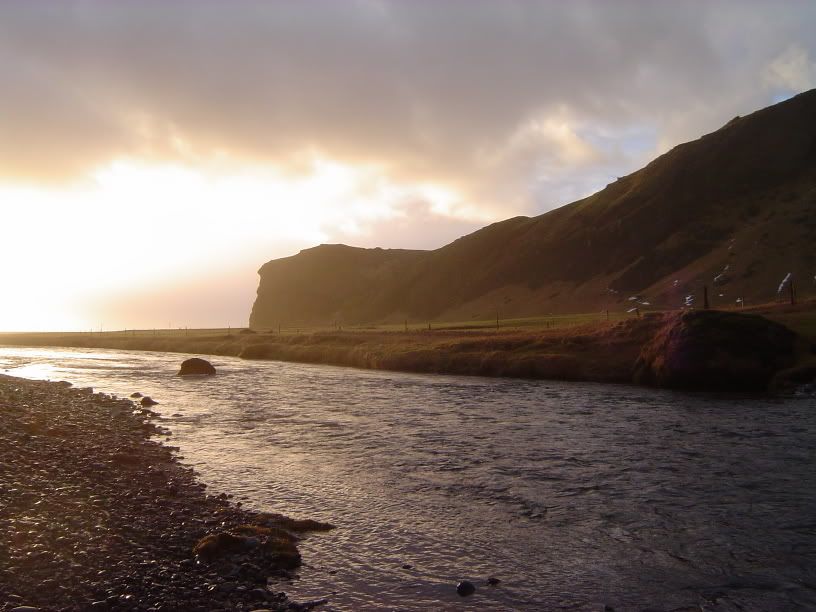
I took this pic in Iceland in December 2003 or January 2004. south coast.
Wednesday, January 02, 2008
Overcoming Fear
I have been reading a lot lately and that is one thing I'm going to try to cut back on in 2008. Both of the authors who I have been reading advise against the the folly of reading too many books and the accumulation of too much stagnant knowledge. Those are outrageously backward ideas on the surface and one has to speculate why an author would advise against reading. The answer lies in the way we are educated.
We are taught to read the most inane material under the guise of "classics" and we are told that such works hold the key to our lives. We are usually between ten and twenty years old when we are told these things. No one knows anything at that age. The work that finally did in Henry Miller and led to his dropping out of college was Edmund Spencer's "The Fairie Queen". Like Miller, I can't imagine a work more irrelevant to the lives of 99.999999% of the people on the planet.
The second author, Napoleon Hill, brings up the fact that the facualty of a great university commands the collected knowledge of civilization but by and large college professors hold a miniscule amount of the world's financial wealth. His examples of "uneducated" men who reaped great rewards from little formal education include Henry Ford and Thomas Edison.
Miller's and Hill's separate philosophies can be brought to assembled in one sentence:
Read deeply from a few books which hold meaning for you at this stage in your life and then put the knowledge gleaned from these books to use with an organized plan.
Both men ultimately write about success and self-realization. Like so many others before and after them their secret to success lies in following your personal dreams and passions. Believeing in yourself and your well-thought out ideas.
Miller didn't learn this secret to happiness and self actualization until he was forty years old. That’s when he left his postion as personnel director for Western Union and moved to Paris to live on the streets as penniless bohemian artist. Hill learned the philosphy over the course twnty years by interviewing more than 500 successful men from the first third of the twentieth century.
Miller and Hill both point out the symptoms of people who haven't discovered and pursued this secret to self realization. Hill goes so far as to lay out the principals of inaction as a series of fears:
Fear of poverty, fear of criticism, and fear of ill-health (which I transpose with fear of growing old). I recognize these fears in my own life and the result of these fears. Shortness with other people, lack of belief in one's ability to follow through and be profitable, cynicism, distrust of others, loss of enthusiasm, and a steady succession of minor sicknesses.
I always remember my grandfather, who was the only successful entreprenuer I've ever known, told me, "Don't let your life be dictated by fear." There is so much truth in these words. I plan to take his advise in 2008.
We are taught to read the most inane material under the guise of "classics" and we are told that such works hold the key to our lives. We are usually between ten and twenty years old when we are told these things. No one knows anything at that age. The work that finally did in Henry Miller and led to his dropping out of college was Edmund Spencer's "The Fairie Queen". Like Miller, I can't imagine a work more irrelevant to the lives of 99.999999% of the people on the planet.
The second author, Napoleon Hill, brings up the fact that the facualty of a great university commands the collected knowledge of civilization but by and large college professors hold a miniscule amount of the world's financial wealth. His examples of "uneducated" men who reaped great rewards from little formal education include Henry Ford and Thomas Edison.
Miller's and Hill's separate philosophies can be brought to assembled in one sentence:
Read deeply from a few books which hold meaning for you at this stage in your life and then put the knowledge gleaned from these books to use with an organized plan.
Both men ultimately write about success and self-realization. Like so many others before and after them their secret to success lies in following your personal dreams and passions. Believeing in yourself and your well-thought out ideas.
Miller didn't learn this secret to happiness and self actualization until he was forty years old. That’s when he left his postion as personnel director for Western Union and moved to Paris to live on the streets as penniless bohemian artist. Hill learned the philosphy over the course twnty years by interviewing more than 500 successful men from the first third of the twentieth century.
Miller and Hill both point out the symptoms of people who haven't discovered and pursued this secret to self realization. Hill goes so far as to lay out the principals of inaction as a series of fears:
Fear of poverty, fear of criticism, and fear of ill-health (which I transpose with fear of growing old). I recognize these fears in my own life and the result of these fears. Shortness with other people, lack of belief in one's ability to follow through and be profitable, cynicism, distrust of others, loss of enthusiasm, and a steady succession of minor sicknesses.
I always remember my grandfather, who was the only successful entreprenuer I've ever known, told me, "Don't let your life be dictated by fear." There is so much truth in these words. I plan to take his advise in 2008.
Thursday, December 27, 2007
Bachelor Cooking Granny Style
Tonight I made a supper of salmon patties. I prefer pan fried salmon filets (and only wild caught at that) but sometimes I'll get a can of skin and bones straight from Alaska and fry up patties. I mix a short can with one egg, some black pepper, a splash of lime juice, and a good dose of Old Bay. Once a girl from New Orleans told me that using Old Bay didn't make me a gourmet but it definately makes a wide variety of things taste better. I'm sure she would have been less critical if I had used Zataran's.
Mix the above ingredients together then lightly coat each patty in corn meal. Be sure to have a hot frying pan with a good splash of olive oil in it ready to throw the patty into as soon as its out of the corn meal. I fried them about three or four minutes on each side over medium/medium high heat. I recommend to serve with tobasco or louisiana brand hot sauce at the table.
Steamed brussell's sprouts and triscuits go well as side items. As you can see I don't eat very complicated but its fairly healthy.
I'm meeting a friend out tonight so I had a ball jar of ice water to wash down dinner but if you're ready for something with a little more kick I recommend a Sierra Nevada Pale Ale. Goes great with the fish.
Mix the above ingredients together then lightly coat each patty in corn meal. Be sure to have a hot frying pan with a good splash of olive oil in it ready to throw the patty into as soon as its out of the corn meal. I fried them about three or four minutes on each side over medium/medium high heat. I recommend to serve with tobasco or louisiana brand hot sauce at the table.
Steamed brussell's sprouts and triscuits go well as side items. As you can see I don't eat very complicated but its fairly healthy.
I'm meeting a friend out tonight so I had a ball jar of ice water to wash down dinner but if you're ready for something with a little more kick I recommend a Sierra Nevada Pale Ale. Goes great with the fish.
Wednesday, December 26, 2007
A Short Epic Poem About Good Things
Short poems are not like taking a road trip to the Utah canyon country to have a spiritual awakening.
Short poems are like a dog wagging its tail...but not for long...like a dog does immediately before you feed it.
Short poems are not fun to sit and try to get into while reading in bed or on the beach;
Short poems are good for the long term of forever because they get stuck in that place in the brain just past annoying, the place where inspiration dwells
or comfort
or solace
or peace.
Our lives are epic poems with short passages worth remembering.
Her name was Alicia, her name was Susan,
Her name was Mazy and she was a good dog.
Her name was Elinor and she was a steep mountain
She was a river and her name was the Duck.
And if you only take one thought from this poem of the passage of my life and what I think is important then let it be:
I reach out my hand to pluck the golden orb of the ripe peach.But my fingers are only long enough to scrape the refreshing dew on its lustrous skin. So I smell the sweetly nectarized air and hold the fruit only in my mind, where it is surly sweeter than any peach ever tasted.
Short poems are like a dog wagging its tail...but not for long...like a dog does immediately before you feed it.
Short poems are not fun to sit and try to get into while reading in bed or on the beach;
Short poems are good for the long term of forever because they get stuck in that place in the brain just past annoying, the place where inspiration dwells
or comfort
or solace
or peace.
Our lives are epic poems with short passages worth remembering.
Her name was Alicia, her name was Susan,
Her name was Mazy and she was a good dog.
Her name was Elinor and she was a steep mountain
She was a river and her name was the Duck.
And if you only take one thought from this poem of the passage of my life and what I think is important then let it be:
I reach out my hand to pluck the golden orb of the ripe peach.But my fingers are only long enough to scrape the refreshing dew on its lustrous skin. So I smell the sweetly nectarized air and hold the fruit only in my mind, where it is surly sweeter than any peach ever tasted.
Friday, December 21, 2007
Crazy Horse September 2003

I call this photo Ambition. Honestly I can't think of a more ambitious undertaking than reshaping a mountain into the dynamic image of a great leader. Perhaps my favorite thing about this photo are the trucks, trailer, and unfinished road, showing that even Ambition is a work in progress. For more information about the sculptor go to
http://www.crazyhorse.org/story/korczak.shtml
His life story makes good reading (because I cringe at the term "inspirational").
Thursday, December 20, 2007
War Doesn't End
Here I am singing a song I wrote. I play it all over town and have had some interest from publishers (a couple of them are big time) but no one can figure out who would record this song.
Tuesday, February 06, 2007
As I Lay Dying - A Review
Yesterday with a post Super Bowl aching head I finished off the last thirty-five pages of William Faulkner's As I Lay Dying. I hadn't read a Faulkner book since Light In August back in '94. I was hesitant because he is sooo thick and heavy at times. What I rediscivered in As I Lay Dying is how much humor he injects in his writing while still being heavy, nihilistic, and existential. What I did find to be difficult still is that Faulkner doesn't exactly hit the reader over the head with a new developement. He slips it in from the side or back door with a well placed phrase that the reader must catch.
As I Lay Dying is the story of a family trying to bury their dead mother. They ride around nine days with her in the back of the wagon in summer...in Mississppi...and its raining a lot of the time. Faulkner tells the story from the point of view of a series of different charcters: there's pretty Dewey Dell, queer Darl, angry Jewel, lazy Anse, stoic Cash, observant Peabody, etc etc. At first the story moves at a snails pace but then one gets the groove of Faulkner's rhytm and the narrative takes form. Issues covered in the novel are adultery, abortion, class, and...and stupid kids or something. Vardaman keeps thinking his mother is a fish...I never figured that one out. The book is full of classic Faulkner sentences, my favorite being, "Squatting, Dewey Dell's wet dress shapes for the dead eyes of three blind men those mammalian ludicrosities which are the horizons and the valleys of the earth."
As I Lay Dying is Faulkner's fifth novel. It was written in six weeks and published in 1930 while he was working at a power plant. I remember the quip he made to his supervisor when he worked at the post office and he ignored his customers because he was deeply involved in wiriting on the job. When confronted about his poor customer service he said, "I'm not at the beck and call of every two bit sonofabitch who wants to buy a postage stamp!"
Yesterday I went to the used bookstore to pick up The Sound And The Fury to continue my Faulkner phase but wound up with Lady Chatterley's Lover.
As I Lay Dying is the story of a family trying to bury their dead mother. They ride around nine days with her in the back of the wagon in summer...in Mississppi...and its raining a lot of the time. Faulkner tells the story from the point of view of a series of different charcters: there's pretty Dewey Dell, queer Darl, angry Jewel, lazy Anse, stoic Cash, observant Peabody, etc etc. At first the story moves at a snails pace but then one gets the groove of Faulkner's rhytm and the narrative takes form. Issues covered in the novel are adultery, abortion, class, and...and stupid kids or something. Vardaman keeps thinking his mother is a fish...I never figured that one out. The book is full of classic Faulkner sentences, my favorite being, "Squatting, Dewey Dell's wet dress shapes for the dead eyes of three blind men those mammalian ludicrosities which are the horizons and the valleys of the earth."
As I Lay Dying is Faulkner's fifth novel. It was written in six weeks and published in 1930 while he was working at a power plant. I remember the quip he made to his supervisor when he worked at the post office and he ignored his customers because he was deeply involved in wiriting on the job. When confronted about his poor customer service he said, "I'm not at the beck and call of every two bit sonofabitch who wants to buy a postage stamp!"
Yesterday I went to the used bookstore to pick up The Sound And The Fury to continue my Faulkner phase but wound up with Lady Chatterley's Lover.
Thursday, February 01, 2007
When Reading Is Difficult Aim Higher
I've had a hard time reading lately. My mind races a thousand miles an hour until I lay down in bed and open a book then my eyes lids become sandbags and sleep the curtain. Brought down with an unflattering flourish of drool.
I've read:
- about half of Henry Miller's The Air Conditioned Nightmare - boring, no real narrative
- reread Hemingway's A Clean, Well-Lighted Place - awesome...makes more sense every five years or so when I reread it
- the first looooong chapter of Freethinkers by Susan Jacoby - okay but between the recent biographies of Roosevelt, Lincoln, and Jackson I need a break from history
- maybe a chapter of Return To Wild America - an aging bird watcher talking about watching birds...an AARP ad
- 1/3 of Steppenwolf by Herman Hesse - a bit depressing and a bit too theater of the absurd for my liking
- The Norton critical guide to T.S. Eliot's The Waste Land - a difficult poem and I hope to find the point of it all in the contemporary critical essays in this book.
But now, yesterday I settled on As I Lay Dying by Wm Faulkner. Excellent book. I'm 50 pages into and will finish it. Published in 1930, the book was written in six weeks while Faulkner worked at a power plant. This is the novel after his magnum opus, The Sound And The Fury. Faulkner is a writer one has to work up to. He is a challange, sort of like a sublime (or grotesque) John Steinbeck, but his characters are outstanding. This is the 3rd of his books I've read.
I've read:
- about half of Henry Miller's The Air Conditioned Nightmare - boring, no real narrative
- reread Hemingway's A Clean, Well-Lighted Place - awesome...makes more sense every five years or so when I reread it
- the first looooong chapter of Freethinkers by Susan Jacoby - okay but between the recent biographies of Roosevelt, Lincoln, and Jackson I need a break from history
- maybe a chapter of Return To Wild America - an aging bird watcher talking about watching birds...an AARP ad
- 1/3 of Steppenwolf by Herman Hesse - a bit depressing and a bit too theater of the absurd for my liking
- The Norton critical guide to T.S. Eliot's The Waste Land - a difficult poem and I hope to find the point of it all in the contemporary critical essays in this book.
But now, yesterday I settled on As I Lay Dying by Wm Faulkner. Excellent book. I'm 50 pages into and will finish it. Published in 1930, the book was written in six weeks while Faulkner worked at a power plant. This is the novel after his magnum opus, The Sound And The Fury. Faulkner is a writer one has to work up to. He is a challange, sort of like a sublime (or grotesque) John Steinbeck, but his characters are outstanding. This is the 3rd of his books I've read.
Monday, January 22, 2007
Three Pillars Of Civilization
This is the time of year for travel. I haven’t been flying about like I used to but it wasn’t long ago that I would roll up a couple of changes of clothes, pack them in a seabag and head for the airport. It was during this packing that I had to be sure to throw my trusty Swiss army knife into the bag so I wouldn’t wind up at security with it in my pocket. I’ve lost good knives that way.
I’ve had to ruin a good Zippo too. I did not know that lighters weren’t allowed on flights so I had to take apart a new lighter and throw away all the fuel soaked cotton.
These are small concessions when it comes to being more secure when we fly the friendly skies. But I’ve noticed a lot of people don’t carry knives and lighters in their day to day lives.
For all our technological advances I still think there are three basic implements of civilization that every person should carry with them:
A knife, matches or a lighter, and a pen.
A knife is the refined extension of the chipped flint of our earliest ancestors. I prefer to carry a Case yellow handled medium stockman model at the present time but there are a host of options to choose from. A good knife with an interesting handle of bone, stag antler, celluloid, or wood makes a handy tool and a great conversation piece. Another great thing about carrying knives is that people always know something safe to get you for Christmas. You never wind up with that pair of baby blue Izod pants like I once did.
Carrying a lighter could literally save your life. There is nothing more human than the ability and desire to make fire. That few people today can make a fire from rubbing two sticks together doesn't matter if you have a lighter. As Geico would say, “Its so easy even a cave man could do it.” You don’t have to smoke to need a lighter. What if you wanted to burn trash or destroy documents?
Lastly, a pen is the most important implement a person can carry. Unlike a knife or lighter there is hardly ever a time I go out that I don’t need to sign my name or write something down. And before using that plastic Bic the girl at the cash register shoves your way think how many people have picked their nose and then used that pen. In the Navy I used to tell the younger Sailors that a pen was a basic part of their uniform. The salty First Classes and Chiefs had already figured that out (and taught that lesson to me). I carry a medium point retractable Parker in my pocket. Though I am still fond of the Danish pen my dad gave me when I was a little kid. It has a photograph of a pretty girl on it whose swimsuit falls off when I turn the pen upside down. It survived getting confiscated by my tenth grade French teacher and sits on my desk waiting to be turned upside down to this day. Writing utensiles have come a long way since chisels and charcoal.
Your pockets are what you make them. I choose to make mine a triune testimonial to human achievement.
I’ve had to ruin a good Zippo too. I did not know that lighters weren’t allowed on flights so I had to take apart a new lighter and throw away all the fuel soaked cotton.
These are small concessions when it comes to being more secure when we fly the friendly skies. But I’ve noticed a lot of people don’t carry knives and lighters in their day to day lives.
For all our technological advances I still think there are three basic implements of civilization that every person should carry with them:
A knife, matches or a lighter, and a pen.
A knife is the refined extension of the chipped flint of our earliest ancestors. I prefer to carry a Case yellow handled medium stockman model at the present time but there are a host of options to choose from. A good knife with an interesting handle of bone, stag antler, celluloid, or wood makes a handy tool and a great conversation piece. Another great thing about carrying knives is that people always know something safe to get you for Christmas. You never wind up with that pair of baby blue Izod pants like I once did.
Carrying a lighter could literally save your life. There is nothing more human than the ability and desire to make fire. That few people today can make a fire from rubbing two sticks together doesn't matter if you have a lighter. As Geico would say, “Its so easy even a cave man could do it.” You don’t have to smoke to need a lighter. What if you wanted to burn trash or destroy documents?
Lastly, a pen is the most important implement a person can carry. Unlike a knife or lighter there is hardly ever a time I go out that I don’t need to sign my name or write something down. And before using that plastic Bic the girl at the cash register shoves your way think how many people have picked their nose and then used that pen. In the Navy I used to tell the younger Sailors that a pen was a basic part of their uniform. The salty First Classes and Chiefs had already figured that out (and taught that lesson to me). I carry a medium point retractable Parker in my pocket. Though I am still fond of the Danish pen my dad gave me when I was a little kid. It has a photograph of a pretty girl on it whose swimsuit falls off when I turn the pen upside down. It survived getting confiscated by my tenth grade French teacher and sits on my desk waiting to be turned upside down to this day. Writing utensiles have come a long way since chisels and charcoal.
Your pockets are what you make them. I choose to make mine a triune testimonial to human achievement.
Wednesday, January 17, 2007
Alternative Fishing Amid the Buzz of Modern America
Yesterday I assembled my new fishing pole and drove out to J Percy Priest Dam in Nashville to try it out. I sat just below the dam enjoying Nature with Interstate 40 rumbling by just downstream, jets loudly shredding the air a few hundred feet overhead, and titanic power line towers adding their electromagnetic buzz to the scene. A peaceful afternoon. Despite the encroachments of our running world I saw a least bittern and some ducks, female mallards I think. There was also a large buffalo which made a few passes up and down the shoreline right under my nose.
Not many people were fishing, just a few Mexicans enjoying the cheap entertainment, and like most uneducated people, they left their trash, their worm boxes and the plastic bag that held their Cheetos, behind on the river bank to be swept downstream by the next flood. I've never understood people too lazy to pick up their trash. But I admit a certain guilt: as a youth my job on boat outings was to fill the beer bottles my dad and his friends passed to me with water and sink them to the bottom of Center Hill Lake. But that took effort.
For a lure I used a small, floppy plastic crappie with a treble hook on the bottom of it. It didn't take many casts to decide this was not going to garner much attention in such a river setting. I needed worms or dough. What I had was a Cliff Bar. So I balled a small pinch of the energy bar around a barbed hook and cast out. Over the course of ninty minutes I caught zero fish but had about four good tugs. My conclusion: a Cliff Bar will catch a fish but you have to make sure enough of the point is exposed to set the hook.
Not many people were fishing, just a few Mexicans enjoying the cheap entertainment, and like most uneducated people, they left their trash, their worm boxes and the plastic bag that held their Cheetos, behind on the river bank to be swept downstream by the next flood. I've never understood people too lazy to pick up their trash. But I admit a certain guilt: as a youth my job on boat outings was to fill the beer bottles my dad and his friends passed to me with water and sink them to the bottom of Center Hill Lake. But that took effort.
For a lure I used a small, floppy plastic crappie with a treble hook on the bottom of it. It didn't take many casts to decide this was not going to garner much attention in such a river setting. I needed worms or dough. What I had was a Cliff Bar. So I balled a small pinch of the energy bar around a barbed hook and cast out. Over the course of ninty minutes I caught zero fish but had about four good tugs. My conclusion: a Cliff Bar will catch a fish but you have to make sure enough of the point is exposed to set the hook.
Subscribe to:
Posts (Atom)

